


A thread lift is a non-surgical procedure that uses temporary sutures under the skin to lift sagging tissue; a facelift is surgery that repositions the deeper facial layers for a longer-lasting result. They look similar from the outside, but the depth of the work, the recovery, the risks and the longevity are not the same. This page is an honest comparison so a reader can decide which question to take to a consultation.
The practice performing facelift surgery at Life Fourways Hospital does not perform thread lifts, so this page is written as a comparison rather than a recommendation for either option. If a reader is weighing the two and wants to know what a surgical facelift involves at this practice, the contact details for a consultation sit at the foot of the page.
What is a thread lift?
A thread lift is a non-surgical procedure that lifts sagging skin using medical-grade threads placed under the skin through a small cannula. The threads hold the tissue in a lifted position and trigger a rise in collagen production. They come in several forms (cat or fox eye, eyebrow, nose, and neck thread lifts) and are made from absorbable materials such as polydioxanone (PDO).
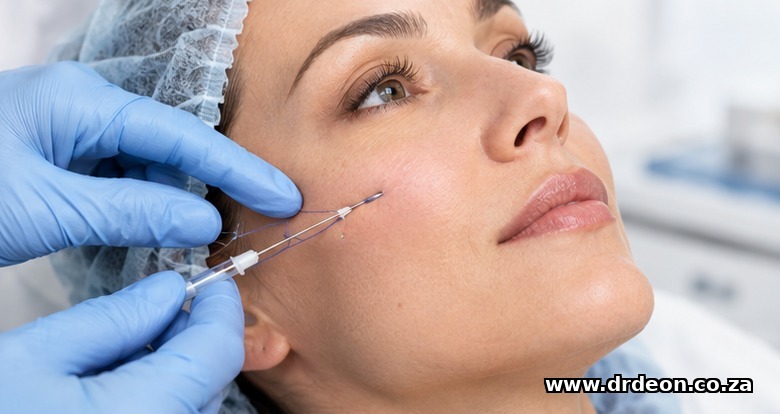
Cleveland Clinic patient information states that results are temporary, lasting from one to three years, after which the procedure can be repeated. A thread lift is reversible in that a surgeon can remove the threads, which distinguishes it from surgery.
What is a surgical facelift?
A surgical facelift (rhytidectomy) lifts and repositions the soft tissues of the face and neck, not only the skin. Modern techniques work beneath the skin, on a layer called the superficial musculoaponeurotic system (SMAS), the sheet of muscle and connective tissue that gives the face its shape. By tightening and repositioning this layer, the lift looks natural and holds longer than skin-only tightening.
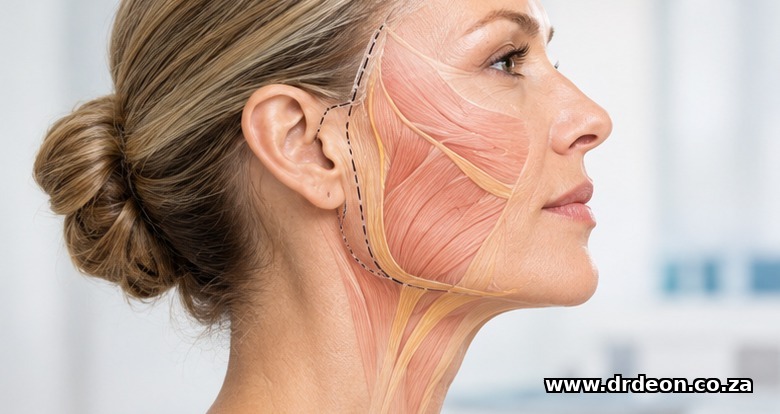
A surgical facelift is performed in theatre under general anaesthetic. Incisions are placed in front of the ear and into the hairline, the deeper tissues are repositioned, and excess skin is trimmed. The American Society of Plastic Surgeons describes the procedure as one that addresses sagging skin, jowls, and loose neck tissue by lifting the underlying structures of the face and neck. At this practice, facelift surgery is performed by Dr Deon Weyers at Life Fourways Hospital in Johannesburg, including the deep plane facelift variant, which releases the retaining ligaments beneath the SMAS.
Thread lift vs facelift: side-by-side comparison
| Feature | Thread lift | Surgical facelift |
|---|---|---|
| Approach | Non-surgical, sutures under the skin | Surgery, incisions in front of the ear and into the hairline |
| Anaesthetic | Local anaesthetic, sometimes with light sedation | General anaesthetic |
| Setting | In-rooms procedure | Hospital operating theatre |
| Tissue plane worked on | Subcutaneous, with a collagen response | SMAS, and (in deep plane) beneath the retaining ligaments |
| Best suited to | Early signs of ageing, mild laxity | Moderate to advanced sagging of face and neck |
| Typical longevity | One to three years (Cleveland Clinic) | Years, with the result driven by deeper repositioning |
| Downtime | Days; most return to work immediately | Weeks of visible swelling and bruising, with residual swelling for months |
| Reversible | Threads can be removed by the surgeon | Not reversible; revision surgery only |
Longevity: how long does each result actually last?
Thread lifts fade on a predictable timeline because the threads dissolve and the collagen response they trigger plateaus. Cleveland Clinic places the typical window at one to three years, with the lift gradually settling back towards baseline.
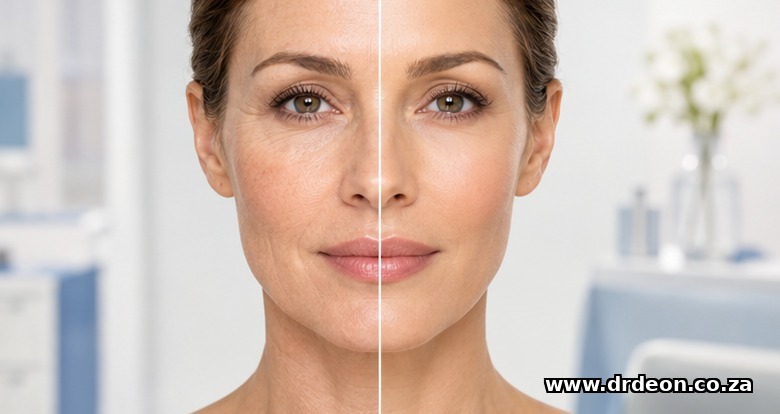
A surgical facelift lasts longer because the work is done at a deeper layer. Repositioning the SMAS, and in a deep plane facelift releasing the retaining ligaments beneath it, moves the structural support of the face rather than relying on a foreign material under the skin. The result still ages with the patient, but the starting point after surgery is meaningfully different, and that difference persists for years.
Candidacy: who each option suits
Cleveland Clinic describes the typical thread lift candidate as someone in their late thirties to early fifties, in the early stages of facial ageing, who does not expect a dramatic change and does not want cosmetic surgery. Thread lifts are also used to refresh an earlier facelift or for patients whose medical conditions rule out a general anaesthetic.
A surgical facelift suits patients with visible laxity along the jawline, jowls, and neck, whose anatomy would not get enough correction from a non-surgical lift alone. Candidacy is assessed in person and depends on skin quality, bone structure, medical history, anaesthetic risk, and what the patient wants the result to look like.
Recovery and downtime
Thread lift recovery is short. Cleveland Clinic patient information describes some swelling and bruising for up to five days, with most people back at work immediately and a recommendation to wait two weeks before vigorous exercise. Facelift recovery is longer: visible swelling and bruising settle over two to three weeks for most patients, with residual swelling that can take several months to fully resolve.
Risks and complications
Thread lift complications, per Cleveland Clinic, tend to be uncommon and include allergic reactions, bleeding, infection, visible or palpable pulling, and lumpiness under the skin. Threads can also migrate or become visible through the skin, and the result can be asymmetric or shorter-lived than expected.
Surgical facelift risks include bleeding, infection, haematoma, injury to the facial nerve that can cause temporary or permanent facial weakness, poor scarring, asymmetry, and the general risks of a general anaesthetic. The point of naming either set of categories is so a reader can ask about them at consultation rather than discover them after the fact.
What most people get wrong
The most common mistake is treating a thread lift as a small version of a facelift. The two procedures work at different tissue planes and on different patient profiles, so the result they can deliver is fundamentally different, not just shorter or longer.
The second is choosing on price alone. Thread lifts are cheaper per session but designed to be repeated, and the lifetime cost can approach a single facelift without delivering the same depth of correction. The third is assuming a thread lift is risk-free because it is non-surgical; Cleveland Clinic lists the same categories (bleeding, infection, allergic reaction) any skin-breaking procedure carries.
Cost considerations in South Africa
Both procedures are elective cosmetic work, so South African medical aids do not cover them. Surgical fees are quoted per patient after an in-person assessment, because the cost depends on the technique, whether other procedures are combined, anaesthetic time, and the facility fee. Patients travelling from outside Johannesburg should factor in the consultation, the procedure day, and the early follow-up window, all of which need to be in person at the Fourways practice.
A note on what this practice offers
Dr Deon Weyers performs surgical facelifts at Life Fourways Hospital in Johannesburg, including the deep plane facelift variant. The practice does not perform thread lifts. If a reader has decided that a thread lift is the right option for them, they will need to see a different provider. If a reader is weighing a thread lift against a surgical facelift and wants to know what surgery involves, candidacy for a surgical facelift is assessed in person. To arrange a consultation, call 011 875 1694 or use the online enquiry form on the contact page.
Frequently Asked Questions
How long does a thread lift last compared to a surgical facelift?
A thread lift typically lasts one to three years before the threads dissolve and the lift settles back. A surgical facelift repositions the deeper tissues and produces a result that holds for years, continuing to age with the patient.
Is a thread lift the same as a mini facelift?
No. A thread lift is non-surgical and uses absorbable sutures under the skin to lift tissue. A mini facelift is a surgical procedure that repositions tissue through small incisions near the ears under anaesthetic, at a different tissue plane.
What are the main risks of a thread lift?
Cleveland Clinic lists uncommon complications including allergic reactions, bleeding, infection, visible or palpable pulling, and lumpiness under the skin. Threads can also migrate or become visible through the skin, and the result can be asymmetric or shorter-lived than expected.
What are the main risks of a surgical facelift?
Surgical facelift risks include bleeding, infection, haematoma, injury to the facial nerve that can cause temporary or permanent facial weakness, poor scarring, and asymmetry, alongside the general risks of a general anaesthetic. Specific risk varies with the patient’s anatomy and history.
Does medical aid cover a thread lift or a facelift in South Africa?
Neither is typically covered, because both are performed for cosmetic indications and South African medical aids do not fund cosmetic surgery. Reconstructive indications, where the procedure is medically necessary, are assessed separately on clinical grounds.
Does this practice offer thread lifts?
No. The practice performs surgical facelifts, including the deep plane variant, at Life Fourways Hospital in Johannesburg, and does not offer thread lifts. Readers who want a thread lift will need to see a different provider.
References
- Thread Lift: What to Expect, Benefits & Complications, Cleveland Clinic, last reviewed 2023.
- Facelift, American Society of Plastic Surgeons patient information.
Considering a procedure? Candidacy is assessed in person. Dr Deon Weyers is a board-certified plastic and reconstructive surgeon registered with the HPCSA, and sees patients at the Fourways practice. Call 011 875 1694 or use the online consultation and photo-review form.
Medical disclaimer. This article is general information about thread lifts and surgical facelifts, not medical advice for any individual reader. Outcomes, recovery, risks and candidacy vary between patients and can only be assessed in person by an HPCSA-registered practitioner. Readers considering either procedure should book a consultation with a qualified surgeon to discuss their own circumstances, medical history and goals.
