


Rhinoplasty (Nose Job) Surgery in South Africa | Dr Deon Weyers
A rhinoplasty, or nose job, reshapes the bone and cartilage of the nose so that it sits in better balance with the rest of the face. Dr Deon Weyers performs it at Life Fourways Hospital in Johannesburg and sees patients from across South Africa.
People consider nose surgery for many reasons: a bump that shows in profile, a tip that droops or looks heavy, a nose that leans to one side after an old injury, or a nose that simply feels out of proportion with the face. The aim is a nose that suits you, not a standard shape.
Every consultation, operation and review is with Dr Deon Weyers himself, a board-certified plastic and reconstructive surgeon registered with the HPCSA. Patients travel to the Fourways practice from Johannesburg, Pretoria, Cape Town and further afield.
Credentials You Can Trust

Book an Online Consultation
The practice will respond to your enquiry.
Credentials You Can Trust
Reviews You Can Trust


Choosing a plastic surgeon is a highly personal decision. Our consistent patient feedback and 4.9-star Google rating reflect the high standard of care, professionalism and patient experience you can expect with Dr Deon Weyers.

Rhinoplasty in South Africa: What It Can and Cannot Change
Rhinoplasty is one of the most individual operations in facial surgery. Two people asking for “a smaller nose” rarely want the same thing, which is why the first conversation is about what bothers you and why, before any technique is discussed.
Rhinoplasty sits within the practice’s facial surgery family, alongside facelift surgery, brow lift and eyelid surgery. It can reduce or build up the bridge, refine or support the tip, narrow the nostrils, straighten a crooked nose and, where needed, improve the internal airway at the same time.
- Bridge and hump
- Tip shape and support
- Nostril width
- Crooked nose
- Airway at the same time
What it cannot do is change your skin. Thick nasal skin limits how fine the tip can look, and thin skin shows every small contour of the framework underneath. Your skin type, the strength of your cartilage and the shape of the rest of your face all set the limits of what a safe, natural result looks like.
Patients come to Fourways from all over the country. City-specific information is on the pages for Johannesburg, Sandton, Pretoria and Cape Town, but the operation, the hospital and the surgeon are the same for everyone.
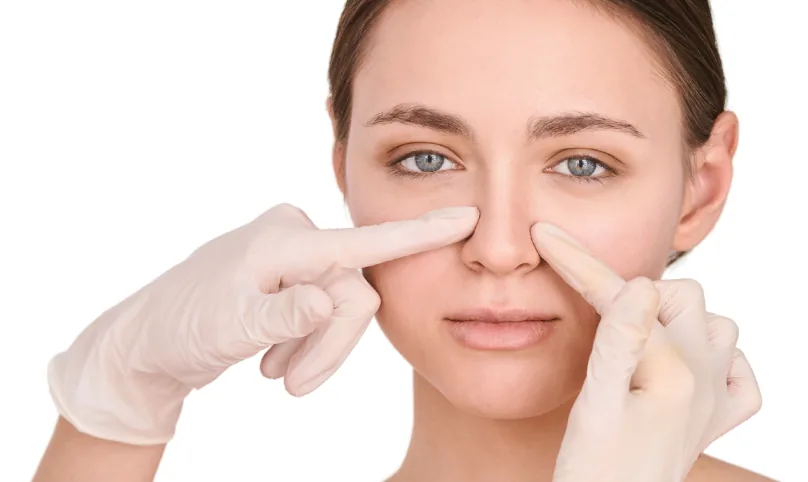
Keeping the Nose in Character With Your Face
A good rhinoplasty is planned around your own features and heritage rather than a template. For many patients the goal is refinement: a softer bump, a slightly better defined tip, a straighter line, while the nose still looks like it belongs to them.
Photographs taken at consultation are used to talk through proportions from the front, the side and below. They help set realistic expectations; they are a planning tool, not a promise of a particular outcome.
The right question is not “how small can my nose be” but “what change would make my face look more balanced, and can my nose support it safely”.
Surgical Rhinoplasty vs Filler-Based “Non-Surgical Nose Jobs”
Surgical Rhinoplasty
Reshapes the bone and cartilage under general anaesthesia. It can reduce a hump, narrow the nose, refine the tip, straighten a crooked nose and address breathing problems.
The change is structural and long term. It involves a hospital procedure, a splint for the first week or so, and swelling that settles over months.
Filler-Based Nose Reshaping
Injectable filler is placed to camouflage small irregularities, for example by filling above and below a bump so the bridge looks straighter. Nothing is removed, so the nose cannot be made smaller.
Effects are temporary and the nose has a delicate blood supply, so injections here carry rare but serious risks. If you are weighing this option, raise it at consultation; this page is about surgical rhinoplasty.
| Aspect | Surgical rhinoplasty | Filler-based reshaping |
|---|---|---|
| Can reduce size or a hump | Yes | No; it can only add volume to disguise a hump |
| Can improve breathing | Yes, when the septum or airway is addressed | No |
| Setting | Hospital theatre, general anaesthesia | Injection procedure |
| How long it lasts | Long term; the framework is permanently changed | Temporary; the filler is gradually broken down |
| Downtime | Splint for 7 to 12 days, swelling settling over months | Short, but with its own injection risks |
| Worth discussing when | You want a lasting structural change | You want a temporary change to a small irregularity |
How Rhinoplasty Surgery Works
Rhinoplasty is done in hospital under general anaesthesia, with Dr Deon Weyers performing the operation himself from start to finish.
Facial analysis
An assessment of the outside of the nose, the inside of the airway, your skin thickness and how the nose relates to your forehead, lips and chin, together with a discussion of what you would like to change.
Agreeing realistic goals
Dr Deon Weyers explains what your anatomy will allow, whether an open or closed approach suits the plan, and whether any breathing surgery is indicated. The plan and quote are confirmed in writing.
Theatre day
The operation takes place at Life Fourways Hospital with an anaesthetist present throughout. Most patients go home the same day or the next morning, depending on the extent of the surgery.
The first one to two weeks
A splint protects the new shape for about 7 to 12 days. Bruising around the eyes usually fades over two to three weeks, and the splint is removed at the practice.
Months one to twelve
Most visible swelling goes within the first few weeks, but the nose keeps refining for 6 to 12 months, the tip being the last area to settle. Follow-up visits track this gradually.
Choosing a Rhinoplasty Surgeon in South Africa
Because rhinoplasty is so individual, who performs it matters as much as the technique. These are reasonable things to check with any practice before you book, including this one.
- Registration and training – The surgeon should be registered with the HPCSA as a specialist plastic and reconstructive surgeon. Dr Deon Weyers is board-certified and a member of APRASSA.
- Who operates – Confirm that the surgeon you consult with is the surgeon who operates and reviews you afterwards.
- Where it is done – Rhinoplasty should be performed in an accredited hospital theatre with an anaesthetist, not in a room set up for minor procedures.
- A written plan – You should leave the consultation knowing what will be changed, how, and what the itemised quote includes.
- Honest limits – A surgeon should be willing to tell you what your nose will not safely allow, as well as what it will.
- Aftercare – Ask how follow-up works, who to call after hours and how a revision would be handled if one were ever needed.
Before-and-after images can help you understand the type of change discussed, but they show individual cases. Your own result depends on your anatomy and healing.
Timing: When Is the Right Time for a Nose Job?
Timing affects both safety and satisfaction. A few practical points help you choose when to have surgery.
- Wait until the nose has finished growing.Cosmetic rhinoplasty is generally considered once facial growth is complete, usually in the later teenage years or older. The decision for younger patients is made carefully, with a parent or guardian involved.
- Allow for visible healing.Plan roughly two weeks before social or work commitments where bruising would be a concern, and avoid surgery just before a wedding, exams or a major event.
- Leave time after an injury.If your nose was recently broken, it may be better to let it heal fully before reconstructive or cosmetic surgery is planned. This is assessed case by case.
- Be in a settled frame of mind.A nose job should be your own decision, not one made under pressure from others or because of a passing trend.
How Much Is a Nose Job in South Africa?
The practice publishes a range of R80,000 to R100,000 for rhinoplasty in South Africa on its rhinoplasty prices page. Where your own fee falls depends on how much needs to change, whether cartilage grafting or breathing surgery is included and how long the operation takes.
You receive a written, itemised estimate after consultation, covering the surgeon, hospital theatre and anaesthetist. Estimates remain valid for six months from the date they are issued. Items such as pre-operative tests or additional hospital nights may be listed separately.
Medical aids generally do not fund cosmetic nose surgery. Where there is a documented breathing problem or a nasal injury, part of the procedure may be considered for cover after a motivation, at the discretion of your scheme.
Common Myths About Rhinoplasty
Many of the worries people bring to a rhinoplasty consultation come from myths. These are the ones worth clearing up early.
Risks and Possible Complications
What Can Go Wrong After a Rhinoplasty
Bleeding and infection: some oozing and the occasional nosebleed are common early on; heavier bleeding or infection is uncommon and is treated promptly.
Shape concerns: minor asymmetry or a small irregularity along the bridge or tip can remain once swelling settles, and a small number of patients go on to have a revision.
Breathing and sensation: the nose may feel blocked while swollen, and the tip can feel numb for some months. Rarely, breathing is worse than before and needs further treatment.
Anaesthesia: the anaesthetist reviews your health and explains the anaesthetic risks before surgery.
How You Can Lower Your Risk
- Avoid smoking and vaping – for several weeks before and after surgery, as nicotine slows healing of the nasal skin.
- Follow the medication list – you are given, including when to stop aspirin, anti-inflammatories and some herbal supplements.
- Sleep with your head raised – for the first week and avoid blowing your nose until you are told it is safe.
- Keep pressure off the bridge – by not resting glasses on it and avoiding contact sports until cleared.
Contact the practice urgently if you have bleeding that does not stop with gentle pressure, rising pain or swelling, a fever, redness spreading over the nose or cheeks, or a sudden change in your breathing. Out-of-hours contact details are given before you go home.
Medical disclaimer. This page is general information and does not replace a face-to-face consultation. Surgical decisions require an in-person assessment, a full consent discussion and the individual medical advice of your surgeon and anaesthetist.
Rhinoplasty South Africa: Frequently Asked Questions
How much is a nose job in South Africa?
The practice publishes a range of R80,000 to R100,000 for rhinoplasty, covering the surgeon, hospital and anaesthetist. Your own fee is confirmed in a written estimate after consultation, depending on how complex the surgery is.
Where is the surgery performed?
At Life Fourways Hospital in Johannesburg, the practice’s single location, under general anaesthesia with an anaesthetist present.
Is rhinoplasty painful?
Most patients describe the first days as uncomfortable rather than very painful, with a blocked feeling from swelling and the splint. Pain relief is prescribed and the practice explains what to expect before surgery.
Will people be able to tell I have had a nose job?
Bruising and swelling are visible for the first couple of weeks. After that, the aim of a well-planned rhinoplasty is a nose that looks natural on your face rather than obviously operated on.
Can rhinoplasty fix a broken or crooked nose?
Often, yes. A nose that has healed crooked after an injury can usually be straightened, sometimes together with breathing surgery. The timing after an injury is decided at assessment.
Is there a minimum age for a nose job?
Cosmetic rhinoplasty is generally considered once nasal growth is complete, usually from the later teens. Younger patients are assessed carefully, with a parent or guardian involved in the decision.
Can I see examples of previous results?
Yes. The rhinoplasty before and after gallery shows individual cases. They illustrate the kind of change discussed and are not a prediction of your own outcome.
How do I start if I live outside Johannesburg?
You can begin with the online consultation and photo review. A face-to-face consultation at Fourways is still needed before any surgery is booked.
Speak to Dr Deon Weyers About Rhinoplasty
Dr Deon Weyers is a board-certified plastic and reconstructive surgeon, registered with the Health Professions Council of South Africa and a member of APRASSA. He sees rhinoplasty patients from across South Africa at the practice in Fourways, Johannesburg.
Call 011 875 1694
Office hours: Monday to Thursday 08:00 – 17:00, Friday 08:00 – 14:00 · send a message
Image credits: Hero, context and final panel image: about-the-practice-fourways-life-hospital-johannesburg.jpg, drdeon.co.za media library.