


A deep plane facelift is surgery that releases the retaining ligaments beneath the SMAS so the deeper facial muscle layer can be repositioned as a single unit; a thread lift is a non-surgical procedure that places temporary sutures under the skin to lift superficial tissue. They look similar in a “before and after” photo, but the two procedures work at different tissue depths, on different patient profiles, with very different longevity and risks.
This page is written for readers weighing the two. It explains what the deep plane technique is, what a thread lift is and is not able to do, and what each option typically suits. It is not written to push one option over the other. The comparison is for the reader; the only decision a reader needs to make on a web page is whether a surgical consultation is worth booking.
The practice at Life Fourways Hospital does not perform thread lifts, so this article is a comparison, not a recommendation for either procedure. Dr Deon Weyers performs the deep plane facelift, among other surgical facelift techniques. Thread lift candidates will need to see a different provider.
What “deep plane” means anatomically
The deep plane facelift is a variant of surgical facelift (rhytidectomy) that works beneath a layer called the superficial musculoaponeurotic system (SMAS), the sheet of muscle and connective tissue that gives the face its underlying shape. The original technique was described by Sam Hamra in 1990 (Hamra, “The deep-plane rhytidectomy,” Plast Reconstr Surg 1990), who showed that releasing the retaining ligaments that tether the SMAS to deeper structures allows the muscle layer to be lifted as a continuous sheet rather than pulled under tension at a few points.
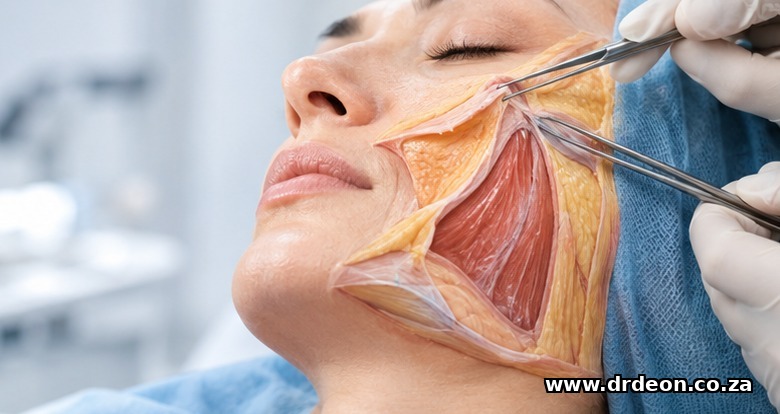
In practice, the surgeon makes an incision in front of the ear (and into the hairline where appropriate), enters the plane just deep to the SMAS, releases specific retaining ligaments, and repositions the muscle layer toward where it sat years earlier. Excess skin is then redraped and trimmed before closure, with little of the lift coming from skin tension. The deep plane facelift practice page describes the same idea in plainer language: structural repositioning rather than surface tightening.
What a thread lift is anatomically
A thread lift is a non-surgical procedure in which fine, absorbable sutures are placed under the skin through a small cannula. The sutures have small barbs that grip the subcutaneous tissue and, when drawn upward, lift the skin and the fat just beneath it.
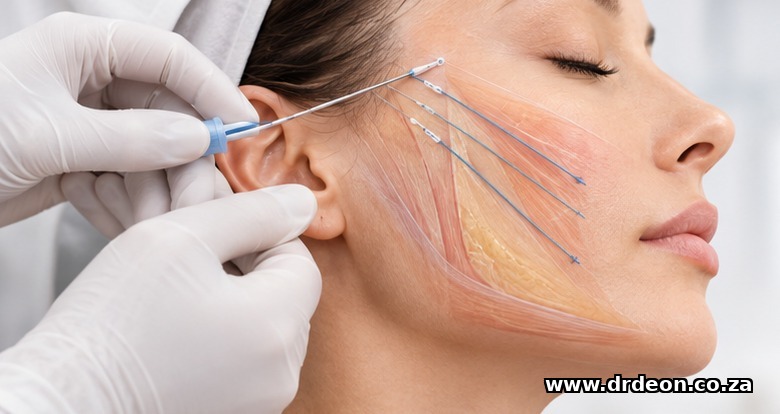
Two things happen at once. There is an immediate mechanical lift as the barbs grip, and there is a slower collagen response as the body reacts to the material. Peer-reviewed work on thread lifting (Fukaya 2017) found that the rejuvenation effect decreased during the first eleven months after the procedure before stabilising. The Fukaya study is about non-absorbable threads; absorbable polydioxanone (PDO) threads, more commonly used in current South African practice, dissolve over several months, so the mechanical lift fades on a similar or shorter timeline.
The anatomical point is that a thread lift does not enter the SMAS plane, does not release retaining ligaments, and does not reposition muscle. It works on the surface layer and relies on foreign material under the skin to hold a position for a limited time.
Side-by-side comparison
| Feature | Deep plane facelift | Thread lift |
|---|---|---|
| Approach | Surgical; incision in front of the ear and into the hairline | Non-surgical; sutures placed through a fine cannula |
| Tissue plane worked on | Beneath the SMAS, after release of the retaining ligaments | Subcutaneous (skin and superficial fat) |
| Anaesthetic | General anaesthetic (sedation with local in selected cases) | Local anaesthetic |
| Setting | Hospital operating theatre | In-rooms, day procedure |
| Best suited to | Moderate to advanced facial laxity, jowling, neck descent | Early or mild laxity in younger patients |
| Mechanism of effect | Repositioning of the muscle layer as a unit | Mechanical lift by sutures plus a collagen response |
| Typical downtime | Weeks of visible swelling, with residual swelling for months | Days; most return to routine quickly |
| Reversibility | Not reversible; revision surgery only | Threads can be removed by a clinician |
Candidacy: who each option suits
A thread lift is typically offered to patients in their late thirties to early fifties with early, mild laxity who want a subtle result, want to avoid surgery, and want a short downtime. It is also used as a refresh for someone who has already had a facelift and wants a small lift without another operation. The mechanical lift is real but limited; a thread can only hold what it grips, from a handful of anchor points.
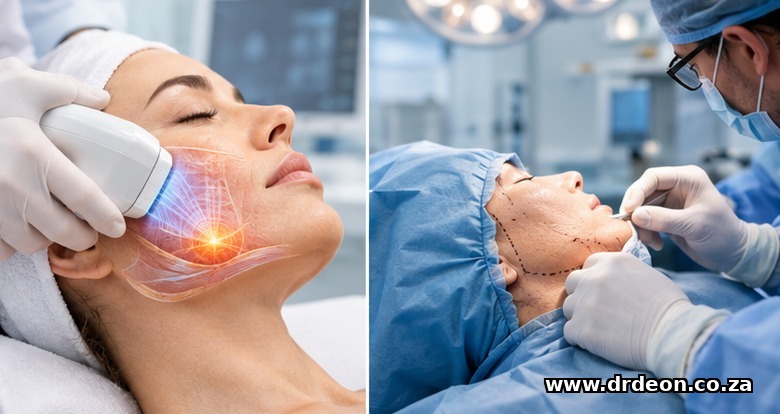
A deep plane facelift suits a different profile. It addresses a degree of facial ageing that is no longer reachable with sutures alone: visible jowling, descent of the cheek pad, deepening of the nasolabial folds, and loose neck skin. Candidacy depends on skin quality, anatomy, medical history, anaesthetic risk, and what the patient wants the result to look like. None of that can be assessed on a web page, and candidacy is determined at consultation, not online.
Longevity and what drives it
Thread lift longevity depends on the thread material and on how the tissue holds the lift as the material breaks down. Fukaya’s 2017 study found that the visible rejuvenation effect decreased during the first year after insoluble-thread lifting before stabilising at a more modest level, with the residual effect driven by new collagen around the threads. For absorbable PDO threads, which dissolve rather than persist, the mechanical component fades sooner; repeat procedures are the norm if the effect is to be maintained.
A deep plane facelift does not depend on foreign material under the skin. By repositioning the muscle and ligament layer as a unit, it changes the structural baseline from which the face continues to age. The result still ages with the patient; sun exposure, smoking, weight change, and bone remodelling all change the trajectory. Longevity in years is harder to source than the mechanism, and a surgeon quoting a specific number should be asked what figure it rests on.
Risks and complications, honestly
Both procedures carry real risks, and an honest comparison has to cover both.
Thread lift complications are uncommon but not rare. Fukaya’s 2017 series reported local infection in about one percent of operations, bruising in around two percent, and palpable or visible threads in about eight percent (Fukaya 2017). Published reviews also describe dimpling or puckering where a thread gathers tissue, thread migration, asymmetry, and, in some cases, an effect that fades faster than the patient expected. The exact profile depends on the thread type, the placement depth, and the clinician’s experience.
Deep plane facelift risks include bleeding, infection, haematoma (a collection of blood under the skin that may need to be drained), injury to the facial nerve causing temporary or, less commonly, permanent weakness in part of the face, poor scarring, asymmetry, and the general risks of a general anaesthetic. Specific risk for an individual patient depends on anatomy, medical history, smoking status, and whether the procedure is combined with other surgery such as a brow lift or blepharoplasty. These risks are real; they are also the reason surgical candidacy is taken seriously at consultation rather than decided online.
What most people get wrong
The most common mistake is treating a thread lift as a small version of a facelift. The two procedures work at different tissue planes; calling a thread lift a “lunchtime facelift” sets a patient up to be disappointed because the result it can deliver is structurally different, not just smaller. A patient with real jowling sold a thread lift will typically come back within months asking about a surgical facelift.
The second mistake is choosing on price alone. A thread lift is cheaper per session, but the session is designed to be repeated. The lifetime cost of several thread lifts can approach or exceed the cost of a single deep plane facelift, without delivering the same depth of correction.
The third mistake is underestimating surgical recovery. Patients sometimes plan a facelift around a two-week event and find that visible swelling and bruising are still present at that point. A realistic deep plane facelift timeline is several weeks of visible recovery and many months of subtle settling, the trade-off being the depth of the work done.
The fourth is assuming a non-surgical procedure is no risk. Thread lifts are lower risk than a facelift, but not no risk; they break the skin and leave material in the body for months.
Cost and the South African context
Both a deep plane facelift and a thread lift are elective cosmetic procedures. South African medical aids do not fund cosmetic surgery, so neither is typically claimable; a reconstructive indication, where the surgery is medically necessary, follows a separate pathway assessed on clinical grounds.
Surgical fees for a deep plane facelift are quoted per patient after an in-person assessment. The cost depends on the technique, whether other procedures are combined, anaesthetic time, and the facility fee; any clinic quoting a single price without seeing the patient is generalising. The practice sees patients from across South Africa at its single Fourways location; the consultation, the procedure, and the early follow-up all need to be planned for in person. The general facelift information page describes what a first consultation involves.
Thread lifts are not offered at this practice. Readers who have decided that a thread lift is the right option for them will need to see a different provider. Readers who are weighing a thread lift against a surgical facelift, and who want to know what the surgery actually involves, are welcome at a surgical consultation; call 011 875 1694 or use the online enquiry form on the contact page.
Frequently Asked Questions
What is the anatomical difference between a deep plane facelift and a thread lift?
A deep plane facelift works beneath the SMAS, after the surgeon releases the retaining ligaments that tether the muscle layer, and repositions the muscle as a unit. A thread lift works at a more superficial level, lifting skin and subcutaneous tissue with barbed sutures, without entering the SMAS plane.
How long does a thread lift last?
Thread lift longevity varies with the thread material. Fukaya’s 2017 study reported that the visible rejuvenation effect decreased during the first eleven months before stabilising at a more modest level; absorbable PDO threads typically lose the mechanical lift component within a similar window because they dissolve, and the collagen response is modest.
Who is a good candidate for a thread lift?
Thread lifts suit patients in their late thirties to early fifties with mild, early laxity who want a subtle result, avoid surgery, and accept a short downtime. They are also used to refresh the result of a previous facelift without another operation.
Who is a good candidate for a deep plane facelift?
Deep plane facelifts address a degree of ageing a thread lift cannot reach, including jowling, descent of the cheek pad, deep nasolabial folds, and loose neck skin. Candidacy depends on anatomy, history, and anaesthetic risk, and is assessed at consultation.
What are the main risks of a thread lift?
Fukaya’s 2017 series reported local infection in around one percent of operations, bruising in about two percent, and palpable or visible threads in about eight percent. Published reviews also describe dimpling, thread migration, and asymmetry as characteristic minor complications.
What are the main risks of a deep plane facelift?
Risks include bleeding, infection, haematoma, injury to the facial nerve causing temporary or permanent facial weakness, poor scarring, asymmetry, and the general risks of a general anaesthetic; specific risk varies with the patient’s anatomy, history, and any combined procedures.
Does medical aid cover a deep plane facelift or a thread lift in South Africa?
Both are elective cosmetic procedures and are not typically covered. A reconstructive indication, where the surgery is medically necessary, follows a separate pathway assessed on clinical grounds; the medical aid should be contacted directly for funding questions.
Does this practice perform thread lifts?
No. The practice performs surgical facelifts, including the deep plane technique, but does not perform thread lifts. Readers who have decided on a thread lift need to see a different provider.
A note on candidacy and the next step
Whether a thread lift or a deep plane facelift is the right option for a specific reader is decided at consultation, not on a web page. Only an in-person assessment can weigh the reader’s anatomy, history, and goals. Candidacy for a surgical facelift at this practice is assessed at consultation.
Considering a procedure? Candidacy is assessed in person. Dr Deon Weyers is a board-certified plastic and reconstructive surgeon registered with the HPCSA, and sees patients at the Fourways practice. Call 011 875 1694 or use the online consultation and photo-review form.
Medical disclaimer. This article is general information about surgical and non-surgical facial rejuvenation options, not medical advice for any individual reader. Outcomes, recovery, candidacy, and longevity vary between patients and can only be assessed in person by an HPCSA-registered practitioner. Readers should consult a qualified specialist about their own circumstances before deciding on any procedure.
