


Combining blepharoplasty with a facelift means performing eyelid surgery and a facelift during a single anaesthetic, addressing the upper-eyelid region together with the lower two-thirds of the face in one operation. Surgeons frequently plan the two together because facial ageing tends to affect both areas at once, and operating on them in one sitting avoids a second recovery and keeps the result visually balanced. This page covers why the two procedures are combined, how each one is performed, what recovery looks like, the recognised risks, who is a candidate, and what the procedure does not guarantee.
The article is general information about a combined surgical option. Individual candidacy, recovery and outcome depend on anatomy, health history and the assessment made at an in-person consultation.
Why a facelift and blepharoplasty are often planned together
Facial ageing is rarely confined to one region. Skin laxity, fat descent and volume changes tend to appear together across the brow, the eyelids, the midface and the jawline, and the way each area ages affects how the others are perceived. A facelift addresses the lower two-thirds of the face and the neck by repositioning the underlying tissue layers and redraping the skin. Blepharoplasty addresses the upper or lower eyelids by removing or repositioning excess skin, muscle and periorbital fat.
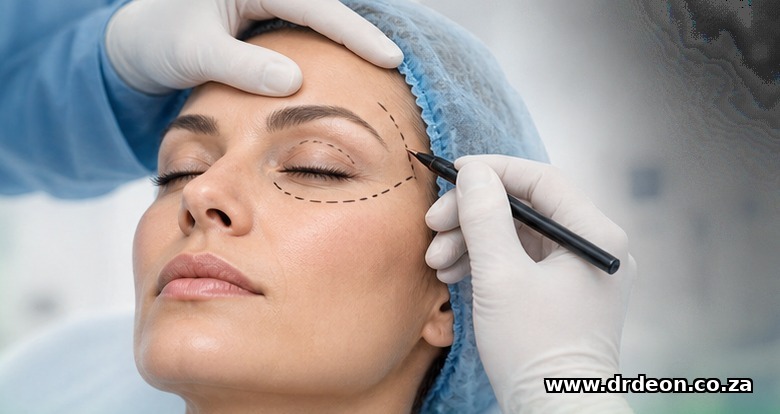
When a patient is bothered by both the eyelid region and the lower face, treating only one area can leave the other looking out of step with the result. The Mayo Clinic patient-information page on blepharoplasty notes that eyelid surgery is frequently done at the same time as a face-lift or a brow lift for exactly this reason. Combining the two also means one anaesthetic, one hospital admission and a single recovery period, rather than two separate ones.
What blepharoplasty addresses, and what a facelift does not
A standard facelift does not lift the eyelids. The lower face and the neck are repositioned, but the periorbital region sits outside the facelift dissection. Upper-eyelid concerns (hooding, excess skin that sits on the lash line, sometimes a heavy fold that limits peripheral vision) and lower-eyelid concerns (bags, loose skin, festoons) need to be addressed separately.
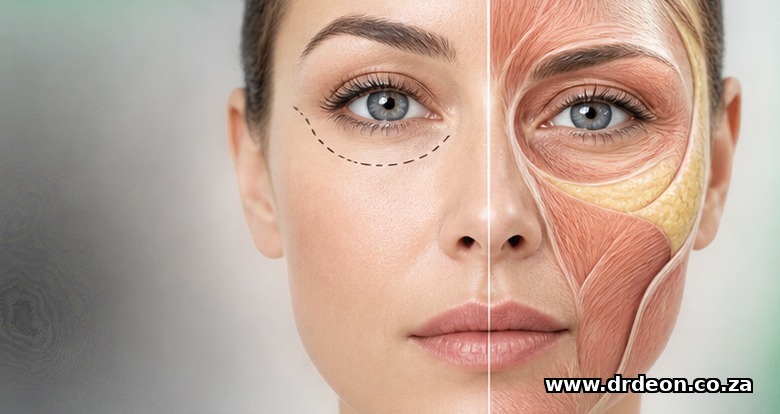
Blepharoplasty, in turn, does not lift the brow or tighten the lower face. The American Society of Plastic Surgeons patient information on blepharoplasty describes upper and lower eyelid surgery as procedures focused on the eyelid skin, the orbicularis oculi muscle and the orbital fat compartments. The PMC peer-reviewed overview of blepharoplasty describes the procedure as the surgical treatment of excess eyelid skin and orbital fat, with the brow and the cheek as related but separate anatomical regions. In short, the two procedures share a recovery but not an operative field.
How the combined procedure is performed
A combined blepharoplasty with facelift is performed under general anaesthetic in a hospital operating theatre. The sequence is planned in advance and typically begins with the facelift dissection, because the position of the cheek and the lower face influences how much skin needs to be removed from the lower eyelids to avoid a downward pull. The blepharoplasty component is then completed on the upper and/or lower eyelids as agreed in the surgical plan.
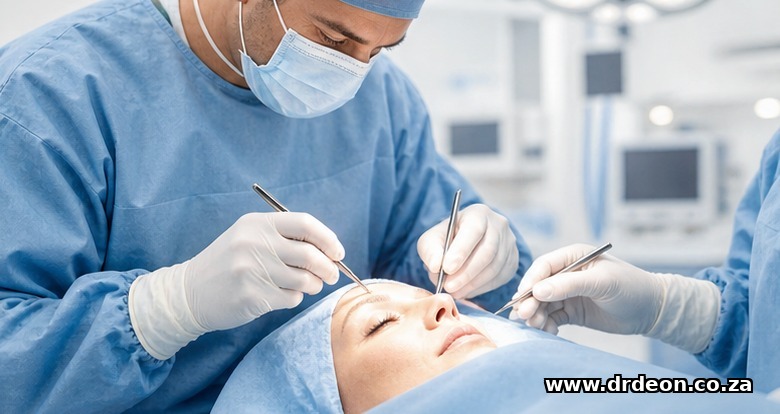
- Anaesthesia and preparation. General anaesthetic, with the anaesthetist monitoring throughout. The surgical sites are marked before anaesthetic induction.
- Facelift component. Incisions are placed in front of and behind the ear (and sometimes under the chin), the deeper tissue layer (often referred to as the SMAS, the superficial musculoaponeurotic system) is tightened, and the skin is redraped without tension.
- Blepharoplasty component. For the upper eyelid, an incision is hidden in the natural crease; excess skin and a strip of orbicularis muscle are removed and the ROOF (retro-orbicularis oculi fat) is conservatively addressed. For the lower eyelid, an incision is made just below the lash line or, in some cases, on the inside of the lid (transconjunctival approach), with fat repositioned rather than removed where possible.
- Closure and dressings. Fine sutures or skin adhesive close the eyelid incisions; the facelift incisions are closed in layers. A light dressing is applied. Most patients stay in hospital for one night.
The combined operation typically runs longer than either procedure alone, and operating time depends on the extent of each component and whether other procedures (such as a brow lift or fat grafting) are added. At DW Skin & Body, every consultation, procedure and follow-up is with Dr Deon Weyers personally.
Recovery timeline
Recovery after a combined procedure is longer than after either component on its own, because both regions swell and bruise at the same time. The schedule below is a general range; individual healing depends on the extent of surgery, skin type, age and adherence to aftercare instructions.
| Stage | What is typical |
|---|---|
| First 48 hours | Dressings in place, swelling and bruising at their worst, mild discomfort managed with prescribed analgesia. Head elevated, cold compresses as instructed. |
| Week 1 | Bruising visible on the cheeks and around the eyes. Sutures usually removed around day 5 to 7. Most patients are up and about at home but not yet ready for social outings. |
| Weeks 2 to 3 | Bruising fades enough that makeup can be used. Most patients feel comfortable returning to desk-based work and light social activity around the end of week 2. |
| Weeks 4 to 6 | Swelling continues to settle. Strenuous exercise, heavy lifting and contact sports are gradually reintroduced. The eyelid incisions begin to fade. |
| Months 3 to 6 | Residual swelling settles. Numbness around the cheeks and ears improves. Final eyelid and facelift contours become easier to judge. |
| Up to 12 months | Incision lines mature and continue to fade. Final scarring assessed at the one-year review. |
Dr Deon Weyers reviews healing at set intervals after the procedure and adjusts activity guidance based on what is seen at each visit, rather than on a fixed calendar.
Risks and complications
Every surgical procedure carries recognised risks. The PMC peer-reviewed overview of blepharoplasty lists the standard complication categories for eyelid surgery, which apply whether the blepharoplasty is done alone or as part of a combined case. For the facelift component, the recognised complications are those of any lower-face soft-tissue procedure.
- For the eyelid component: dry or irritated eyes, temporary blurring of vision, asymmetry between the two sides, visible scarring, lower-lid retraction (a downward pull on the lower lid), difficulty closing the eyes, and in rare cases injury to the eye muscles or changes to skin sensation.
- For the facelift component: bleeding or haematoma (a collection of blood under the skin), infection, temporary or permanent numbness around the cheeks and ears, asymmetry, visible scarring (typically hidden in the hairline and around the ear), nerve injury affecting facial movement (rare), and skin loss at the edges of the flap in smokers.
- For the combined case specifically: longer operating time under general anaesthetic (which carries its own risks), longer total recovery, and a higher overall burden of swelling and bruising in the first two weeks.
Specific risk factors, including smoking, poorly controlled blood pressure, diabetes, dry-eye syndrome and certain medications, are reviewed at consultation. Reducing those that can be modified before surgery is part of standard preparation, not an optional extra.
Candidacy and what the consultation is for
Candidacy for a combined blepharoplasty with facelift is not decided from a web page. The Mayo Clinic patient information on blepharoplasty is clear that candidacy depends on eyelid anatomy, general health, eye health (including dry eye and visual field issues) and the patient’s own goals for the result. The same applies to the facelift component.
At consultation, the surgeon assesses the upper-face and lower-face ageing pattern together, reviews the medical and ophthalmic history, examines eyelid position and tear film, and discusses what the combined procedure can realistically address. Dr Deon Weyers is a board-certified plastic and reconstructive surgeon, registered with the Health Professions Council of South Africa (HPCSA) and a member of APRASSA.
Common mistakes to avoid
- Treating the eyelids from a facelift alone. A facelift does not lift the eyelids. Patients hoping the lower-face work will tidy up hooding or lower-lid bags are usually disappointed, and a revision is then needed.
- Choosing between the two without an assessment. Ordering the procedures in advance (eyelids first or facelift first) without an in-person assessment can lead to two separate recoveries and an unbalanced result. The order and combination are surgical decisions.
- Underestimating the combined recovery. The combined procedure is a longer recovery than either component alone. Returning to heavy exercise or contact sports too early is a common cause of wound complications.
- Assuming medical aid will fund it. Blepharoplasty with a facelift is most often performed for cosmetic reasons. The Mayo Clinic page notes that insurance coverage depends on whether the surgery repairs a condition that harms vision. In South Africa, the same principle applies: funding depends on the clinical indication and the medical aid’s rules, and should be confirmed with the scheme before booking.
- Skipping the discussion of risk. A combined procedure carries the risks of both components. A consultation that does not cover dry eye, haematoma, scarring and revision is incomplete.
Cost
The cost of a combined blepharoplasty and facelift is quoted per patient after assessment, because it depends on what each component involves, the anaesthetic time, the hospital setting and whether other procedures are added at the same time. There is no general price list. Readers are directed to a consultation for an individual quote, and to their medical aid for the funding question.
Frequently Asked Questions
Can blepharoplasty and a facelift be done at the same time?
Yes. Blepharoplasty and a facelift are routinely performed in a single operating session under general anaesthetic, because facial ageing affects both areas together and a single combined procedure keeps the upper and lower face visually balanced while avoiding a second recovery.
Does a facelift include eyelid surgery?
No. A standard facelift addresses the lower two-thirds of the face and the neck. The eyelids sit outside the facelift dissection and are treated separately as a blepharoplasty, either at the same operation or as its own procedure.
How long is recovery after a combined blepharoplasty and facelift?
Most patients return to desk-based activity around the end of week 2, with visible bruising fading over weeks 2 to 4. Strenuous exercise is usually reintroduced from week 4 to 6, residual swelling settles over months 3 to 6, and incision lines continue to mature for up to 12 months.
Is a combined blepharoplasty and facelift safe?
The procedure carries the recognised risks of both components, including dry or irritated eyes, lower-lid retraction, haematoma, infection, scarring and temporary numbness, plus the longer anaesthetic time of a combined case. Risk depends on anatomy, general health and individual factors reviewed at consultation.
Will a combined blepharoplasty and facelift be covered by medical aid in South Africa?
Funding depends on the clinical indication and the medical aid’s rules. Where the eyelid component is performed to address a documented visual-field problem, partial funding of that component is sometimes possible; the cosmetic element is generally not funded. Confirm with the medical aid before booking.
How do I know if I am a candidate for the combined procedure?
Candidacy is assessed at an in-person consultation, not online. The surgeon reviews eyelid position, brow position, lower-face ageing, eye health (including dry eye), medical history and individual goals before recommending whether the two procedures should be combined, staged, or performed separately.
References
- Blepharoplasty, Mayo Clinic patient information.
- Eyelid Surgery (Blepharoplasty), American Society of Plastic Surgeons patient information.
- Nahas et al., Blepharoplasty: An Overview, PMC, NIH (2009).
Medical disclaimer. This article is general information about a combined blepharoplasty and facelift procedure and is not medical advice for any individual reader. Outcomes, recovery and candidacy vary between patients and can only be assessed in person. Speak to an HPCSA-registered practitioner about your own circumstances before making any decision. The DW Skin & Body practice is located at Suite B22, Life Fourways Hospital, Cnr Cedar Road & Cedar Avenue West, Fourways, Johannesburg, 2191.
Candidacy for a combined blepharoplasty and facelift is assessed at an in-person consultation. To arrange one, call 011 875 1694 or use the online consultation and photo-review form. See the standalone blepharoplasty and facelift pages for the individual procedures. The practice is rated 4.9 stars on Google.
