


Yes, but timing matters. A facelift after weight loss can address the loose skin, hollowed cheeks and sagging neck that often follow significant weight loss. The result, however, depends on reaching a stable weight before surgery, because losing further weight afterwards can undo some of the improvement.
The peer-reviewed review by Couto and colleagues at the Cleveland Clinic Foundation describes how weight loss produces two parallel changes in the face: loss of the soft tissue volume that keeps the skin supported, and a degree of inelasticity in the skin envelope that has been stretched for a long time. Those two changes are what a facelift is asked to correct, and they are also what determines who is ready for one (Couto et al., Clinics in Plastic Surgery, 2019).
What follows is a candid guide to the timing question, what weight loss does to the face, and what to weigh honestly before booking surgery.
What weight loss does to your face
Significant weight loss, whether through diet and exercise, bariatric surgery, or the newer GLP-1 medications such as semaglutide, removes fat from the face as well as the body. The fat pads in the cheeks and around the temples that give the face its youthful volume shrink. The skin that was stretched over that volume does not always tighten fully back, especially if the weight was carried for years or carried quickly.
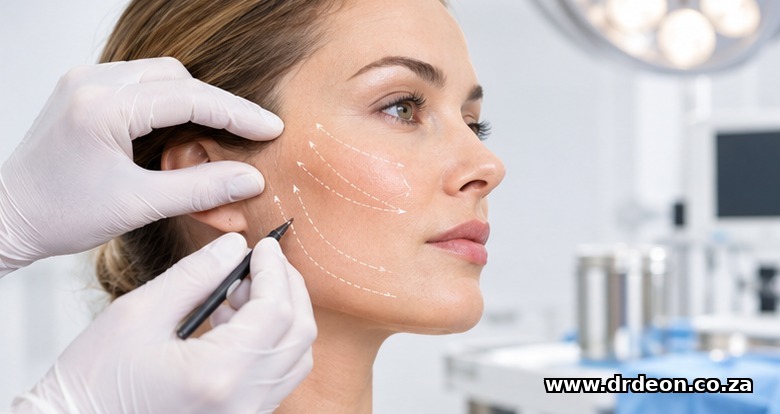
The result is a recognisable set of changes. The cheeks look hollow. The temples sink. The nasolabial folds, the lines running from the nose to the corners of the mouth, deepen. Jowls appear or worsen. The neck develops loose, hanging skin, sometimes called a “turkey neck”. The overall effect is an aged look that can seem at odds with how the rest of the body now appears. The same mechanism is what clinic copy refers to as “Ozempic face” when the weight loss has come from GLP-1 medication.
The Couto review frames this clearly: weight loss produces volume deflation and redundant inelastic skin that parallel the changes of natural ageing, which is why post-weight-loss patients often look older than their chronological age (Couto et al., 2019). That framing matters because it explains why a facelift is one of the surgical options that genuinely addresses the problem, rather than a cosmetic add-on.
Should you lose weight before a facelift?
If you are still actively losing weight, the honest answer is to wait. A facelift is planned against the face you have at the time of surgery. If that face is still changing, the result is planned against a moving target. The American Society of Plastic Surgeons advises patients to be at a stable weight they can maintain before a facelift, so that the surgical plan matches the tissues the surgeon will actually be working on (ASPS, 2026).
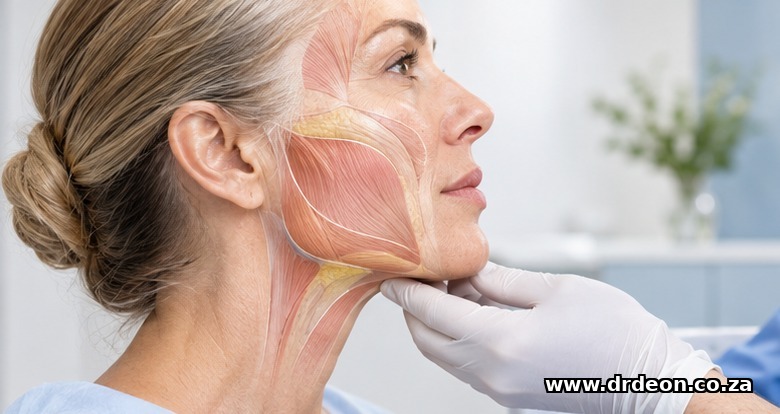
“Stable” is the operative word. Most surgeons treat a weight that has held within a small range for at least three to six months as stable enough to plan against. The exact range is set at consultation and depends on your starting weight, your method of weight loss, and how your body tends to fluctuate. Your surgeon needs to see the face you will live with, not the face you are passing through.
Body contouring surgeons, who work with massive-weight-loss patients routinely, use a similar rule for tummy tucks and arm lifts. The principle is the same: plan surgery against a stable anatomy, not a transitioning one.
What about weight loss after a facelift?
This is the question patients tend to ask only after they have booked surgery, and it is the one to settle in advance. Yes, weight loss after a facelift can affect the result. The mechanism is the same in reverse: facial fat that the surgical result was relying on for support shrinks, and the skin that was redraped over a fuller face now sits on a smaller frame.

The practical effect is that some of the early signs of ageing the surgery corrected can return. Hollowing in the cheeks, fine lines around the mouth, and a return of neck laxity are the typical patterns. Fat that was grafted into the face during surgery can also shrink with systemic weight loss, which is why some surgeons use structural techniques such as a deep plane lift that work on the deeper muscular layer rather than relying on grafted volume alone.
None of this means a facelift is wasted if you lose weight later. It means the surgery is best timed when you are at the weight you intend to maintain, and that any further weight change is discussed openly with your surgeon before booking. A small amount of weight loss is unlikely to undo a well-performed lift, because the deeper structural work holds. A large or rapid weight loss is a different conversation.
Risks and complications to weigh honestly
Post-weight-loss facelift surgery carries the recognised risks of any major operation under general anaesthetic, plus a small set specific to the face and neck. These include haematoma (a collection of blood under the skin that sometimes needs to be drained), infection, temporary or rarely persistent facial nerve weakness affecting expression, visible or widened scarring, asymmetry between the two sides, patches of skin loss (more common in smokers), anaesthetic complications, and the possibility of a revision procedure.
Weight loss adds two specific considerations. The first is that redundant skin is harder to redrape cleanly, so the surgical plan needs more extensive skin undermining than a facelift in a patient who has not lost significant weight. The Couto review identifies extensive skin undermining as the single most critical technical modification in this group (Couto et al., 2019). The second is nutritional. Patients who have had bariatric surgery in particular need their blood work reviewed for anaemia, protein status, and vitamin levels before any elective surgery, because healing depends on adequate nutritional reserves.
Health status influences the risk profile more than weight history alone does. This is why the pre-operative work-up matters, and why candidacy is always decided in person against your specific blood work, your medical history, and your goals.
Common mistakes to avoid
- Booking surgery while still losing weight. A facelift planned against a face that is still changing is planned against the wrong face. Reach the weight you intend to maintain, hold it, and book from there.
- Assuming fillers will do the job of a facelift. Dermal fillers and fat transfer can restore some lost volume, but they do not address significant loose skin on the jawline and neck. If there is redundant skin, a surgical lift is the honest answer, not a non-surgical workaround.
- Hiding weight-loss plans from the surgeon. Whether the weight loss came from diet, bariatric surgery or a GLP-1 medication, the surgeon needs the full picture to plan the operation and the recovery properly. Surprises in the recovery period are exactly what the consultation is meant to prevent.
- Choosing a technique by weight change alone. The decision turns on the tissues you have now, not on the weight you used to be. A deep plane lift, a stem cell facelift that combines a lift with fat transfer, and a less invasive option each suit different tissue patterns. Your surgeon will match the technique to your anatomy, not to the number on your scale.
- Stopping nutrition support too soon after bariatric surgery. If you have had a gastric bypass or sleeve, your surgeon’s pre-op work-up will include a nutritional review. Treat that as part of the surgical plan, not an optional extra.
Candidacy is decided in person
This page gives general information about how facelift timing and weight loss are thought through. It is not a substitute for a personal assessment, and it cannot tell you whether a facelift is the right operation for you. Candidacy is determined at a consultation against your face, your tissue quality, your weight trajectory and your health.
DW Skin & Body performs facial surgery procedures across its facial surgery family, including deep plane facelifts, stem cell facelifts that pair a lift with fat transfer, brow lifts, blepharoplasty and other facial procedures. Dr Deon Weyers is a board-certified plastic and reconstructive surgeon registered with the Health Professions Council of South Africa and a member of the Association of Plastic, Reconstructive and Aesthetic Surgeons of Southern Africa. At the practice, the consultation, the procedure and the follow-up are all with Dr Weyers personally, the practice’s only surgeon.
An online photo-review through the contact page is a useful first step if you are based outside Johannesburg. The in-person consultation is where candidacy is properly determined. The practice sees patients from across South Africa at its Fourways practice, including those considering a facelift after significant weight loss, where health and tissue quality support it. To arrange a consultation, call 011 875 1694.
Frequently Asked Questions
Should I lose weight before a facelift?
If you are still actively losing weight, wait. A facelift should be planned against the face you will live with, not a face that is still changing. Most surgeons recommend reaching a stable weight you can maintain, typically held for three to six months, before booking surgery.
Will losing weight after a facelift ruin my results?
Significant weight loss after a facelift can soften the result. Facial fat that supported the lifted tissues shrinks, and grafted fat can lose volume with systemic weight loss. A small amount of weight loss is unlikely to undo a well-performed lift; a large or rapid weight loss is a different conversation to have with your surgeon before surgery.
Can I have a facelift after bariatric surgery?
Yes, with appropriate preparation. Patients who have had bariatric surgery need their blood work reviewed for anaemia, protein status and vitamin levels before elective surgery, because healing depends on adequate nutritional reserves. Most bariatric surgeons also recommend waiting until weight has been stable for several months before any body or facial contouring procedure.
How long after weight loss should I wait before a facelift?
Most surgeons recommend waiting until your weight has been stable for at least three to six months. That window allows your skin to recover as much elasticity as it will, gives your nutrition time to stabilise, and lets the surgeon plan the operation against the face you will keep.
Does Ozempic or GLP-1 medication affect facelift results?
GLP-1 medications such as semaglutide cause weight loss that includes facial fat loss, which produces hollowed cheeks, deeper folds and loose neck skin in some patients. If you are on a GLP-1 medication, the timing question is the same as for any weight loss: reach a stable weight before surgery, and tell your surgeon you are taking the medication so the anaesthetic and recovery plan can account for it.
Is a facelift worth it after massive weight loss?
Many patients find that a facelift after massive weight loss restores a facial appearance that matches their body, addressing hollow cheeks, jowls and loose neck skin that diet and exercise alone cannot fix. The result is long-lasting when weight is stable and tissue quality is adequate. Candidacy is always assessed in person against your specific anatomy and health.
Considering a procedure? Candidacy is assessed in person. Dr Deon Weyers is a board-certified plastic and reconstructive surgeon registered with the HPCSA, and sees patients at the Fourways practice. Call 011 875 1694 or use the online consultation and photo-review form.
Medical disclaimer. This article is general information about how weight loss and facelift surgery interact, including timing, candidacy and risks. It is not medical advice for any individual and does not replace an in-person consultation. Outcomes, recovery, scarring and candidacy vary between patients and can only be properly assessed in person by an HPCSA-registered practitioner. Readers considering a facelift after weight loss should consult a qualified plastic and reconstructive surgeon about their own circumstances. If you are based in South Africa, confirm your surgeon’s registration with the Health Professions Council of South Africa.
