


A forehead lift is a surgical procedure that softens deep horizontal creases across the forehead, reduces frown lines between the brows, and lifts low or drooping brows to a more rested position. It is often discussed alongside a brow lift, and the two terms are used interchangeably in many surgical texts. This article explains what a forehead lift addresses, how it differs from a brow lift, who typically considers it, what the procedure and recovery involve, and what the recognised risks are.
DW Skin & Body lists this family of procedures as brow lift in its facial surgery offering, reflecting how the surgical planning is described in the practice. The anatomy involved, the techniques used, and the outcomes a patient can expect are closely aligned with what is more commonly called a forehead lift in patient information. If a reader is weighing one or the other, the same consultation process applies.
Candidacy for any upper-face rejuvenation surgery is always assessed in person. The points below describe the procedure in general terms so a reader can decide whether a consultation is worth pursuing.
Forehead Lift vs Brow Lift: How They Relate
Brow lift and forehead lift are often treated as the same procedure. The American Society of Plastic Surgeons describes the two as overlapping surgical plans that target the upper third of the face, with the choice of term reflecting which concern the surgeon is emphasising in the consult (ASPS, 2024). In patient information they are routinely interchangeable.
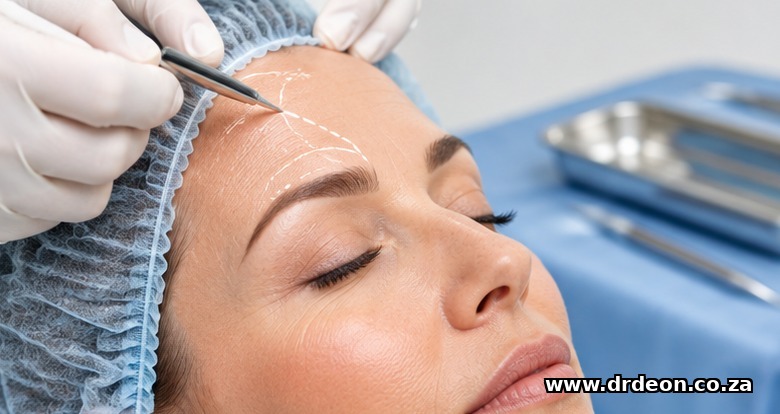
In practical terms, surgeons tend to talk about a brow lift when the priority is repositioning low or heavy brows, and about a forehead lift when the priority is also smoothing the deep horizontal lines across the forehead and the vertical frown lines between the eyebrows. The incision plan, the layer of tissue being released, and the recovery profile are similar either way. A reader researching “forehead lift” and a reader researching “brow lift” will usually arrive at the same surgical discussion.
The Association of Plastic, Reconstructive and Aesthetic Surgeons of Southern Africa (APRASSA) describes the same procedure as a forehead lift that “removes excess tissue, alters muscles and tightens the forehead skin,” and notes it is most often done together with a facelift to maximise the cosmetic result (APRASSA).
What a Forehead Lift Addresses
A forehead lift is intended to address concerns caused by the soft tissue of the forehead and the position of the eyebrows. The conditions most often described as candidates for the procedure are:
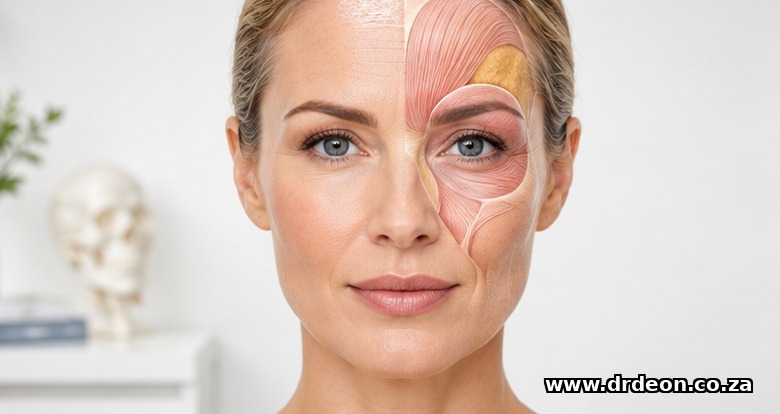
- Horizontal creases or lines across the forehead.
- Deep vertical lines between the eyebrows, sometimes called the “11” lines or glabellar lines.
- Drooping or low-set eyebrows that give a tired or heavy appearance.
- Skin hanging at the outer part of the upper eyelids, sometimes called hooding.
- A high hairline that the procedure can lower when the incision is planned along the frontal hairline.
A forehead lift does not address facial volume loss, surface skin texture changes, or dynamic wrinkles caused by repeated expression. Those concerns are typically managed with other approaches, such as fat grafting, fillers, skin resurfacing, or neurotoxin injections, and are sometimes combined with a forehead lift when several concerns sit together.
Who Considers a Forehead Lift
Patients considering a forehead lift typically present with one or more of the changes described above. Most are in their 40s to 60s, but the procedure is also performed on younger patients with inherited concerns such as a low-set brow or deep frown lines, and on older patients where drooping brows interfere with the upper field of vision.

Candidacy depends on factors that cannot be assessed from a web page: brow position relative to the bony orbital rim, skin quality and thickness, hairline height, hair density, medical history, medications, smoking status, and what the patient is hoping to change. A forehead lift is not appropriate when eyelid closure is already compromised, when prior eyelid surgery would make a brow lift unsafe, or when the underlying concern is best treated with a non-surgical option. These decisions are made at consultation, not online.
How the Procedure Is Done
The procedure is usually performed under general anaesthesia or intravenous sedation with local anaesthesia, on an outpatient basis. APRASSA describes the operation taking one to two hours depending on the technique, with the patient usually returning home the same day (APRASSA).
Several techniques exist, and the choice depends on brow position, hairline height, the severity of wrinkling, and the scar trade-off the patient accepts. The most commonly discussed are:
- Endoscopic forehead lift. Three to five short incisions behind the hairline are used as access points for a small camera and long thin instruments. The attachments contributing to a heavy brow are released, the muscles that cause frown lines can be partially resected, and the soft tissue is resuspended.
- Open or coronal forehead lift. A longer incision runs across the top of the head from ear to ear, behind the hairline. It allows direct access to the forehead muscles and skin and is suited to more advanced sagging or to patients who also want a high hairline lowered.
- Temporal or lateral brow lift. Shorter incisions at the temples address the outer third of the brow. This is a common choice when the central forehead looks acceptable and the concern is the outer brow tail.
- Pretrichial forehead lift. The incision sits just in front of the hairline. It preserves the hair follicles along the line and can be used to lower a high hairline.
- Direct brow lift. An incision is made directly above the eyebrow. It is used less often, typically for significant asymmetry or where other techniques are unsuitable.
After the underlying tissue is released and repositioned, the skin is redraped, excess skin is trimmed where needed, and the incisions are closed with sutures or staples. A supportive dressing is usually applied and removed within a day or two.
Recovery: A Staged Timeline
Recovery varies with the technique used, the patient’s age, and individual healing. The numbers below summarise the typical pattern reported by approved surgical sources; individual recovery can be faster or slower. They are general ranges, not guarantees, and recovery timelines are always reviewed personally with the operating surgeon.
| Stage | What to expect |
|---|---|
| First 48 to 72 hours | Swelling and bruising around the forehead, eyes, and cheeks. Head elevation and cold compresses help. Numbness, tightness, and a headache-like sensation are common. |
| End of week 1 | Bandages removed at one to three days. Sutures or staples usually removed between seven and ten days after surgery. Most endoscopic patients are presentable to return to a desk role within seven to ten days. |
| Weeks 2 to 3 | Bruising fades substantially. Residual swelling persists. Strenuous activity is still restricted. Open technique patients may need slightly longer than endoscopic patients. |
| Weeks 4 to 6 | Gradual return to more vigorous activity. Sun protection on the forehead is important, as the area can pigment if exposed during the first three to six months. |
| Months 3 to 12 | Numbness, itching, or tingling at the incision sites settles. Final contour and scar maturation continue for up to a year. |
APRASSA notes that patients typically return to work within seven to ten days, sooner with an endoscopic lift, and that full recovery from bruising takes two to three weeks. The forehead skin should be protected from sun exposure for several months because pigmentation changes can occur in the first three to six months after surgery (APRASSA).
Risks and Complications
A forehead lift is a surgical procedure and carries the recognised risks of any operation under anaesthesia, plus procedure-specific risks. The categories listed below are drawn from approved surgical sources and are discussed candidly with patients at consultation.
- Bleeding and haematoma (a collection of blood under the skin that may need to be drained).
- Infection.
- Adverse reaction to anaesthesia.
- Damage to the nerves that control forehead and eyebrow movement, which can affect the ability to raise the brows or wrinkle the forehead. This is usually temporary but can be permanent.
- Numbness, itching, or other changes in skin sensation across the forehead and scalp.
- Asymmetry of the brows or of forehead movement.
- Visible scarring, including widened scars, and hair loss along the incision line.
- Skin discoloration or hyperpigmentation, particularly with sun exposure during early healing.
- Dissatisfaction with the result, which can sometimes require revision surgery.
Some risks are specific to the technique used. Endoscopic surgery can occasionally require conversion to an open technique if visualisation is inadequate, leading to a longer scar and recovery. The coronal or open technique carries a higher risk of scalp numbness and of a raised hairline. Patients who have had prior upper eyelid surgery need a careful assessment because a forehead lift can change how the eyelids close.
Common Mistakes to Avoid
Several patterns recur when patients research a forehead lift online. They are worth naming, because each one can lead to a poor outcome or to a consultation that does not address the real concern.
- Treating “forehead lift” and “brow lift” as unrelated. They are routinely the same procedure with a different emphasis. Reading about one and assuming the other is a separate operation leads to two consultations instead of one informed conversation.
- Choosing a technique by scar length alone. The shortest scar is not always the right operation. Endoscopic and temporal lifts do not address deep central frown lines as directly as an open or coronal lift can. The trade-off is individual.
- Underestimating the swelling timeline. Swelling is at its worst around day three and takes weeks to settle. Returning to public or photographed events inside the first two weeks is rarely realistic.
- Assuming medical aid will cover a cosmetic indication. A forehead lift is generally a cosmetic procedure. Coverage may be available where drooping brows demonstrably obstruct the field of vision, and that assessment is done at consultation with documentation.
- Skipping sun protection on the forehead. Sun exposure in the first three to six months can cause pigmentation changes on the forehead. Sunscreen and a hat during this window are not optional.
- Pursuing a forehead lift to fix the eyelids. When the real concern is drooping upper eyelid skin, the operation needed may be blepharoplasty, sometimes combined with a brow lift. The right sequencing is decided on examination, not in advance.
For patients considering facial rejuvenation at DW Skin & Body, the consultation, the procedure and the follow-up are all with Dr Deon Weyers personally. Dr Weyers is a board-certified plastic and reconstructive surgeon, registered with the Health Professions Council of South Africa (HPCSA) and a member of APRASSA.
Frequently Asked Questions
How is a forehead lift different from a brow lift?
A forehead lift and a brow lift are largely the same procedure, with surgeons emphasising brow position when they say brow lift and forehead creases or frown lines when they say forehead lift. The incision plan, the layer of tissue released, and the recovery profile are similar in both.
How long does a forehead lift last?
APRASSA reports the results of a forehead lift usually last five to ten years, depending on the technique, individual ageing, skin quality and sun exposure. The procedure does not stop the ageing process, but the upper-face appearance is generally improved relative to no surgery at all.
When can I return to work after a forehead lift?
Most patients return to a desk job within seven to ten days after an endoscopic forehead lift, and within two weeks after an open or coronal lift. Strenuous activity is usually restricted for several weeks, and final healing continues for several months.
Will I have visible scars after a forehead lift?
Incisions are planned within or just behind the hairline for most techniques, so they are concealed by hair. Visible scarring is more likely when incisions are placed in front of the hairline, in a forehead crease, or directly above the brow, and individual healing influences how noticeable any scar remains.
Can a forehead lift be combined with other procedures?
A forehead lift is commonly combined with a facelift, blepharoplasty, skin resurfacing, or injectables. APRASSA notes that the procedure is most often performed together with a facelift to maximise the cosmetic result across the face, and the combination is decided on assessment.
Candidacy for a forehead lift is assessed in person, taking into account brow position, hairline height, skin quality, medical history and the result you are hoping to achieve. To arrange a consultation, call 011 875 1694, or use the online enquiry form on the brow lift page. The practice is at Suite B22, Life Fourways Hospital, Fourways, Johannesburg.
Medical disclaimer. This article is general information about forehead lift surgery, not medical advice for any individual. Outcomes, recovery and candidacy vary between patients and can only be assessed in person. Readers should consult an HPCSA-registered practitioner about their own circumstances before making any decision about surgery.
