


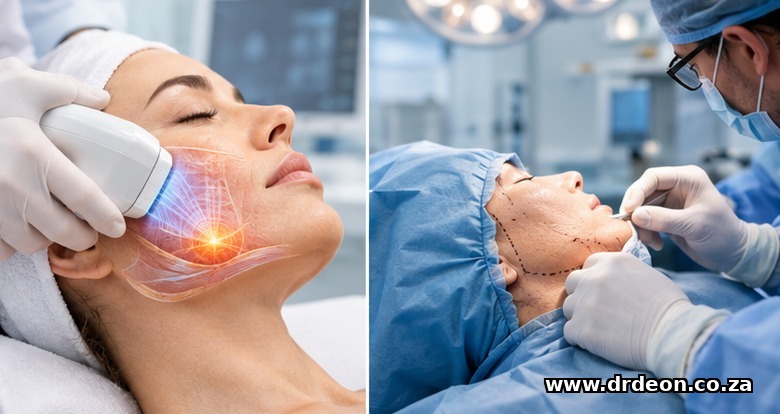
A HIFU treatment and a surgical facelift work on the same anatomical layer, the SMAS, but they reach it in completely different ways and produce results of different magnitudes. HIFU, meaning high-intensity focused ultrasound, delivers focused ultrasound energy through intact skin to create controlled thermal points at depth, triggering collagen remodelling over three to six months. A surgical facelift, technically a rhytidectomy, physically repositions the skin and the underlying SMAS layer through incisions around the hairline and ears.
The honest answer to “HIFU or facelift” is that they are not competing for the same patient. HIFU suits mild to moderate laxity in earlier stages of ageing; a surgical facelift is the appropriate option for more advanced laxity where structural repositioning is required. Candidacy for either option is assessed in person, because skin quality, fat volume, and bone structure all change what is appropriate.
This page covers what each option actually does, where the boundary sits between them, and what to weigh up at consultation. The practice offers a surgical facelift and a HIFU-based non-surgical treatment; the underlying HIFU technology is offered, but candidacy is what decides which option is recommended. For a general overview of the surgical side, see the facelift page, and for the deeper-plane variant, see the deep plane facelift page.
What HIFU actually does
HIFU stands for High-Intensity Focused Ultrasound. The device delivers tightly focused ultrasound waves to a precise depth beneath the skin, raising the temperature at that focal point to a level that creates controlled thermal coagulation. The body responds by producing new collagen in the weeks and months that follow, which gradually tightens and lifts the tissue.
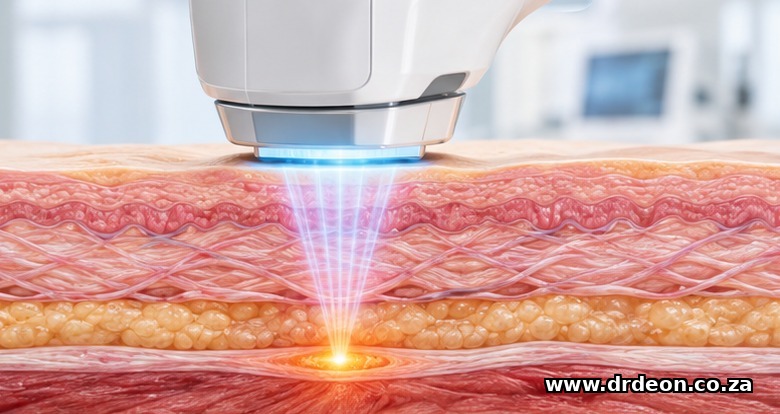
Different cartridge depths are used to target different layers. Superficial depths address fine lines in the upper dermis, intermediate depths address skin firmness, and the deepest depth, typically around 4.5 mm, reaches the SMAS. The SMAS, meaning the superficial musculoaponeurotic system, is the sheet of muscle and connective tissue beneath the skin of the face. It is the same structural layer a surgeon tightens during a facelift. Reaching the same layer is not the same as achieving the same result, and that distinction is the point of this page.
A HIFU session typically takes 30 to 90 minutes depending on the area treated. No anaesthetic is required, although some patients report a brief, hot, prickling sensation during the pulses. There is no formal downtime: most people return to normal activities the same day.
What a surgical facelift actually does
A surgical facelift (rhytidectomy) physically repositions the tissues of the face and neck. The surgeon makes incisions around the hairline and in front of the ears, lifts the skin, tightens and repositions the SMAS layer beneath it, removes excess tissue, and re-drapes the skin before closing. General anaesthesia is standard.
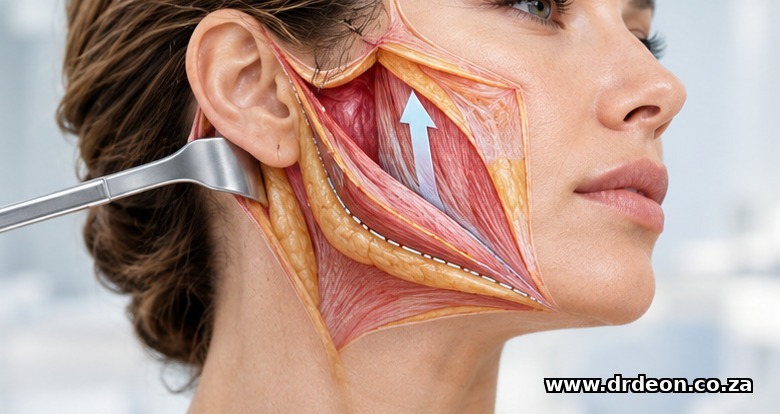
Because the SMAS layer is physically moved rather than heated, the lift is structural. The trade-off is real: general anaesthesia carries its own risk, recovery takes weeks rather than days, and the procedure is permanent. The technique also varies: a deep plane facelift releases the retaining ligaments beneath the SMAS and repositions a thicker composite of tissue, which is generally understood to hold longer than a skin-only lift.
DW Skin & Body offers surgical facelifts as part of its facial surgery family. Where the deeper plane is appropriate, a deep plane facelift is the technique used.
Side-by-side comparison
| Factor | HIFU | Surgical facelift |
|---|---|---|
| How it reaches the SMAS | Focused ultrasound through intact skin | Incisions around the hairline and ears |
| Anaesthetic | None usually required | General anaesthetic |
| Treatment time | 30 to 90 minutes per session | Several hours in theatre |
| Setting | In-rooms | Hospital theatre |
| Downtime | None to minimal, same-day return to most activities | Weeks, with staged return to social activity |
| Best suited to | Mild to moderate laxity, earlier signs of ageing | Moderate to advanced laxity, structural descent |
| Magnitude of lift | Modest, builds over three to six months | Significant, immediate |
| Reversibility | Wears off as collagen turnover continues | Permanent structural change |
| Typical candidates | Patients in their thirties or forties with early jowling | Patients in their fifties or sixties with more advanced descent |
When HIFU makes sense, and when a facelift is the better choice
HIFU is generally worth considering when
- Skin laxity is mild to moderate rather than advanced
- The jawline is softening but not yet heavily descended
- Anaesthesia, incisions, and weeks of downtime are not workable
- The reader is in their thirties or forties, with early jowling or a less defined jawline
- The reader is prepared for a subtle result that builds gradually and may need top-up sessions at review
A surgical facelift is generally the appropriate option when
- There is visible descent of the SMAS layer, with jowling, deepened nasolabial folds, or loss of the cervical angle
- HIFU has already been tried and the patient has reached the limit of what it can do
- The reader is willing to accept general anaesthesia, incisions, and a staged recovery in exchange for a structural lift
- The reader is in their fifties or sixties, where the magnitude of laxity typically exceeds what an energy-based treatment can address
Candidacy for either option is assessed in person. A meaningful assessment cannot be made from a web page, and the in-person consultation is the place where skin quality, fat volume, bone structure, and medical history are all weighed together.
Risks and complications worth knowing
Both options carry risk. The categories of risk are different, and the magnitudes are different. A full risk discussion is part of the consultation and the consenting process, and is not summarised here in a way that substitutes for it.
HIFU risks
HIFU is non-invasive, and serious complications are uncommon when treatment is delivered by an appropriately trained practitioner. Reported effects include transient redness, mild swelling, and tenderness at the treatment site, which typically settle within hours to a few days. Tingling or temporary numbness has been reported and usually resolves on its own. Less commonly, bruising and small thermal burns have been described, particularly where treatment parameters have been set too aggressively for the patient’s skin. Because HIFU uses focused energy, treatment over an area where a permanent filler or a metallic implant sits is generally avoided.
Facelift risks
A surgical facelift is a real operation under general anaesthesia, and the risk profile reflects that. Risks include haematoma, a collection of blood under the skin that may need to be drained, infection, scarring, nerve injury affecting facial movement, asymmetry, and skin loss along the incision lines in smokers, alongside the general risks of anaesthesia. The deep plane technique works at a deeper level and carries its own profile of considerations, which are discussed at consultation. A facelift resets the clock but does not stop ageing, and a revision may be considered in the future.
Common Mistakes to Avoid
- Treating HIFU as a substitute for a facelift when the laxity is already structural. Energy-based treatments work on collagen stimulation; they do not physically reposition tissue.
- Choosing a technique by price. The cheapest HIFU package is rarely the most appropriate one, and the most expensive facelift is not automatically the best fit for a given patient.
- Assuming a single HIFU session is final. Collagen stimulation builds gradually, and a second session or a top-up is often discussed at review.
- Underestimating facelift recovery. Returning to social activity typically happens at two to three weeks, with residual swelling settling over a longer period. Planning time off work and social commitments around that staged recovery matters more than the surgery date itself.
- Skipping the in-person assessment. Photos and questionnaires help, but skin quality, fat distribution, and bone structure can only be evaluated face to face.
- Reading a clinic’s before-and-after gallery as a forecast. Marketing galleries show what is achievable in selected cases; they are not a prediction for an individual outcome.
How candidacy is decided at consultation
At consultation, the surgeon assesses skin laxity, fat volume, bone structure, and the patient’s medical history, and discusses what the patient is trying to change. The two options are not chosen from a menu; they are matched to the underlying anatomy. Where HIFU is appropriate, the practice offers a HIFU-based non-surgical treatment. Where a surgical lift is appropriate, that is what is recommended.
The surgeon also discusses what the procedure will and will not do, including the staged recovery, the scarring placement, and what a realistic outcome looks like for the patient’s face. At DW Skin & Body, the consultation, the procedure, and the follow-up are all with Dr Deon Weyers personally, a board-certified plastic and reconstructive surgeon registered with the HPCSA and a member of APRASSA.
Frequently Asked Questions
Is HIFU as effective as a facelift?
No. HIFU stimulates collagen at depth and produces a modest, gradual improvement, while a surgical facelift physically repositions the SMAS layer and produces a structural lift. They work on the same layer but at different magnitudes, and the choice between them depends on the degree of laxity, which is assessed in person.
How long does HIFU last compared to a facelift?
HIFU results build over three to six months and vary by device, depth treated, and individual collagen response, with top-up sessions often discussed at review. A surgical facelift produces a structural change that holds for years, with the duration depending on the technique, the patient’s skin, and the natural ageing process thereafter.
Can HIFU be used after a facelift?
It can be, but the timing and the indication matter. HIFU may be considered some time after surgery to support skin quality as natural ageing continues, and the question is best discussed at a follow-up consultation rather than planned independently.
Who is a good candidate for HIFU versus a facelift?
HIFU suits patients with mild to moderate laxity, often in their thirties or forties, who want a subtle, gradual change without anaesthesia or downtime. A facelift suits patients with more advanced descent of the SMAS layer, often in their fifties or sixties, where structural repositioning is the appropriate intervention. Candidacy is decided in person.
What is the recovery like for HIFU compared to a facelift?
HIFU has no formal downtime, and most people return to normal activities the same day with possible mild redness or tenderness. A surgical facelift requires a staged recovery, with most patients presentable at around two to three weeks and residual swelling settling over a longer period, with individual variation depending on the extent of the procedure.
Does this practice offer HIFU as a treatment?
The practice offers a HIFU-based non-surgical treatment as part of its non-surgical offerings, alongside surgical facelifts including the deep plane variant. Candidacy for either option is assessed at consultation.
References
- HIFU facial: What is it, how it works, effects, cost, and more, Medical News Today.
Medical disclaimer. This article is general information about HIFU and surgical facelifts, not medical advice for any individual reader. Outcomes, recovery, risks and candidacy vary between patients and can only be assessed in person by an HPCSA-registered practitioner. Readers considering either procedure should book a consultation with a qualified surgeon to discuss their own circumstances, medical history and goals.
Considering a facelift in South Africa? Candidacy for a surgical facelift is assessed in person at our Fourways practice. To arrange a consultation, call 011 875 1694 or use the online consultation and photo-review form.
