


Otoplasty (Ear Surgery) in Johannesburg | Dr Deon Weyers
Otoplasty is surgery that changes the position, shape or size of the ears. Dr Deon Weyers performs it for children and adults at Life Fourways Hospital in northern Johannesburg.
Most people who ask about otoplasty want ears that sit closer to the head. Others are concerned about ears that look large, uneven or misshapen, whether from birth or after an injury. The operation works on the cartilage that gives the ear its shape, usually through an incision hidden behind the ear.
The practice is based at Life Fourways Hospital in Johannesburg. Dr Deon Weyers sees you at the consultation, performs the procedure himself and reviews you afterwards, so there is no handover to another doctor along the way.
Credentials You Can Trust






Book an Online Consultation
The practice will respond to your enquiry.
Credentials You Can Trust
Reviews You Can Trust


Choosing a plastic surgeon is a highly personal decision. Our consistent patient feedback and 4.9-star Google rating reflect the high standard of care, professionalism and patient experience you can expect with Dr Deon Weyers.

Otoplasty Johannesburg: Pinning Back or Reshaping the Ears
Ear surgery is not one single operation. What is done depends on why the ears stand out or look the way they do, and that is worked out by examining the ear, not from a photograph alone. If you have been searching for otoplasty near me in Johannesburg, the first step is a consultation at the Fourways practice.
The shape of the ear comes from a thin, flexible framework of cartilage covered by skin. Prominent ears usually have one of two features: a fold that never formed fully (the antihelical fold) or a deep bowl of cartilage (the concha) that pushes the ear outwards. Ear pinning recreates or reshapes these structures so the ear sits closer to the side of the head. Our article Can otoplasty fix protruding ears? explains this anatomy in more detail.
- Ear pinning
- Ear reduction
- Incision behind the ear
- Children and adults
- Single surgeon
Ear reduction addresses ears that are large in proportion to the face, sometimes including a large earlobe. Some patients need a combination of pinning and reduction on one or both ears. Ears are rarely identical to begin with, so the aim is balance between the two sides rather than a perfect match.
Depending on what is planned, the procedure usually takes between one and three hours. Smaller procedures may be performed in Dr Deon’s rooms, while more extensive surgery, or surgery for younger children, is done in hospital. The full overview of the procedure is on our main otoplasty page.
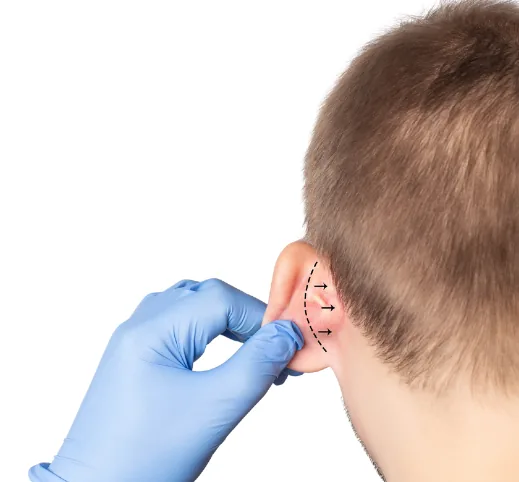
What Ear Surgery Involves
In most cases an incision is made in the natural crease behind the ear, where the scar is hidden from view. Through it the cartilage is reshaped, scored, folded with permanent stitches or, where needed, a small amount is removed. The skin is then closed with stitches.
Local anaesthetic, with or without sedation, can suit adults and older children, while general anaesthesia is often used for younger children or longer procedures. The choice is made with you at the consultation, together with the anaesthetist where one is involved.
Otoplasty changes the cartilage framework of the ear. Because the framework itself is reshaped, the change is intended to be lasting, although ears can shift slightly while they heal.
Ear Pinning vs Ear Reduction
Ear Pinning (Setback Otoplasty)
Brings ears that stick out closer to the head by creating a fold in the cartilage, reducing a deep conchal bowl, or both. The size of the ear is not usually changed.
The most common form of otoplasty. Suited to children from around school age and to adults who have always been self-conscious about prominent ears.
Ear Reduction
Reduces the overall size of an ear, part of the rim or an enlarged earlobe, by removing a measured amount of skin and cartilage.
Suited to ears that are large in proportion to the face, which is more often an adult concern. It can be combined with pinning when ears are both large and prominent.
| Aspect | Ear Pinning | Ear Reduction |
|---|---|---|
| Main concern | Ears that stick out | Ears that look too large |
| What is changed | Cartilage folds and the position of the ear | Size of the rim, cartilage or earlobe |
| Usual incision | In the crease behind the ear | Behind the ear or along the rim, depending on the area |
| Typical patients | Children from about school age, and adults | Mostly adults |
| Anaesthetic | Local or general, agreed at consultation | Local or general, agreed at consultation |
| Can be combined | Yes, with reduction where needed | Yes, with pinning where needed |
The Otoplasty Process in Johannesburg
From the first visit to the final review, you are seen by Dr Deon Weyers at Life Fourways Hospital.
Consultation
Both ears are examined and measured, and you discuss exactly what bothers you. For a child, the child’s own wishes are part of the conversation. The type of surgery and anaesthetic is agreed.
Preparation
You receive instructions about eating before surgery, medication and what to bring. Adults who smoke are asked to stop before and after surgery to help healing.
Surgery
The ear is reshaped through the planned incisions and closed with stitches. The procedure usually takes one to three hours, depending on what is being done.
Dressing and headband
A padded dressing protects the ears at first. Once it is removed, a soft headband is usually worn, especially at night, to protect the ears while they settle.
Follow-up
You return for wound checks and stitch care. Bruising usually fades within 7 to 10 days, and the ears continue to settle over at least six weeks.
Who Considers Otoplasty
Ear surgery is considered by children whose ears are close to adult size and by adults of any age who are bothered by the shape, size or position of their ears.
- Ears that stick out – One or both ears sitting noticeably away from the head
- Large ears – Ears that look out of proportion to the face
- Uneven ears – A noticeable difference between the two sides
- Shape differences from birth – Folds that did not form, or other differences in the cartilage
- Changes after injury – Ears altered by trauma, assessed individually
- Good general health – No medical condition that makes surgery or anaesthesia unsafe
Suitability, the type of surgery and the anaesthetic are confirmed only after a face-to-face examination.
Before You Book Ear Surgery
Practical planning makes the first weeks easier, for adults and for parents of children having surgery.
- Bring photographs if they help.Pictures that show what bothers you can be useful, but the plan is based on examining the ears.
- Ask about the anaesthetic.Find out whether local or general anaesthesia is planned and why, and whether the procedure will be in rooms or in hospital.
- Plan for the headband.Expect to wear a soft headband for a period after surgery, particularly at night. Your review dates confirm how long.
- Pause contact activities.Contact sport and anything that could knock the ears is avoided while they heal. Discuss school or work timing at the consultation.
What Otoplasty Costs in Johannesburg
The practice publishes a range of R50,000 to R60,000 for otoplasty in Johannesburg; see the otoplasty prices in Johannesburg page. A written quote is provided after your consultation, once the exact procedure is known.
Cost depends mainly on whether one or both ears are treated, whether pinning and reduction are combined, and whether the procedure is done under local anaesthetic in rooms or under general anaesthesia in hospital.
Cosmetic otoplasty is generally not covered by medical aids. Where surgery corrects a difference present from birth or an injury, a medical aid may consider a motivation; the practice can advise once the indication is clear.
Common Misunderstandings About Otoplasty
A few assumptions about ear surgery lead to unnecessary worry or unrealistic expectations.
Risks and Possible Complications
Recognised Risks of Otoplasty
General risks: bleeding or a collection of blood under the skin, infection, delayed wound healing and reactions to anaesthesia.
Ear-specific risks: asymmetry between the ears, the ear moving back towards its original position, a visible or thickened scar, a stitch working its way to the surface, and contour irregularities that may need a further procedure.
Sensation: temporary numbness or tenderness of the ear is common; rarely, changes in sensation last longer.
Anaesthetic risks: discussed before surgery, including with the anaesthetist when general anaesthesia is used.
What Reduces Risk
- Keep the dressing clean and dry – until it is removed at your review.
- Wear the headband as advised – to protect the ears while the cartilage settles.
- Avoid knocks and contact sport – until you are cleared to return.
- Report sudden pain early – because it can signal a collection of blood that needs attention.
Seek urgent advice for sudden severe pain in one ear, swelling that keeps increasing, bleeding through the dressing, fever, or discharge from the wound. The practice provides contact details for after-hours concerns.
Medical disclaimer. This page is general information and does not replace a face-to-face consultation. Surgical decisions require an in-person assessment, a full consent discussion and the individual medical advice of your surgeon and anaesthetist.
Otoplasty Johannesburg: Frequently Asked Questions
Where is otoplasty performed?
At Life Fourways Hospital in northern Johannesburg, either in Dr Deon’s rooms for smaller procedures under local anaesthetic or in a hospital theatre. There is no other branch.
From what age can a child have ear surgery?
Ear surgery is commonly considered once the ears are close to adult size, which is often from around six years of age. The child’s maturity and own wishes are also taken into account at the consultation.
How long does the operation take?
Usually between one and three hours, depending on whether one or both ears are treated and whether pinning and reduction are combined.
Will I need to wear a headband?
A soft headband is usually advised after the dressing comes off, particularly at night, to protect the ears while they heal. How long you wear it is confirmed at your review.
When can I go back to work or school?
Many people return to desk work or school within about a week, depending on comfort and the procedure. Contact sport waits until you are cleared.
How much does otoplasty cost in Johannesburg?
The practice publishes a range of R50,000 to R60,000. Your written quote follows the consultation.
Are the results permanent?
Reshaping the cartilage is intended to give a lasting change. Ears can shift a little while healing, and a small number of patients need a minor revision.
Do you see patients from Pretoria as well?
Yes. Patients from Pretoria are seen at the same Fourways practice; see our page on otoplasty for Pretoria patients.
Speak to Dr Deon Weyers About Otoplasty
Dr Deon Weyers is a board-certified plastic and reconstructive surgeon, registered with the Health Professions Council of South Africa and a member of APRASSA. He sees patients for ear surgery at Life Fourways Hospital in Johannesburg.
Call 011 875 1694
Office hours: Monday to Thursday 08:00 – 17:00, Friday 08:00 – 14:00 · send a message
Image credits: Hero, context and final panel image: about-the-practice-fourways-life-hospital-johannesburg.jpg, drdeon.co.za media library..