


Otoplasty (Cosmetic Ear Surgery) in South Africa | Dr Deon Weyers
Otoplasty changes the size, shape or position of one or both ears. Patients from across South Africa are treated by Dr Deon Weyers at Life Fourways Hospital in Johannesburg.
Otoplasty, also called cosmetic ear surgery, corrects ears that stick out, ears that are larger or shaped differently than the patient would like, and ears changed by injury or present differently from birth.
Children from about six years of age and adults can be considered. Every consultation, procedure and follow-up is with Dr Deon Weyers personally at the single Fourways practice.
Credentials You Can Trust






Book an Online Consultation
The practice will respond to your enquiry.
Credentials You Can Trust
Reviews You Can Trust


Choosing a plastic surgeon is a highly personal decision. Our consistent patient feedback and 4.9-star Google rating reflect the high standard of care, professionalism and patient experience you can expect with Dr Deon Weyers.

Otoplasty in South Africa: What Ear Surgery Can Correct
Ear surgery is often searched for as “ear pinning”, but otoplasty covers more than pinning. The right operation depends on what exactly bothers you about the ears.
Prominent ears are the most common reason for otoplasty, and ear pinning brings them closer to the head. Other patients are bothered by the size or shape of the ear, or by one ear that looks different from the other. City-specific information is on the otoplasty Johannesburg and otoplasty Pretoria pages.
- Ear pinning
- Ear reduction
- Ear augmentation
- One or both ears
- Children and adults
The ears are close to adult size by around six years of age, which is why surgery can be considered from then. Adults often seek otoplasty after years of styling their hair to hide their ears.
The procedure usually takes one to three hours and is often an outpatient operation. Depending on its complexity, it may be done in the rooms or in theatre, under local or general anaesthesia.
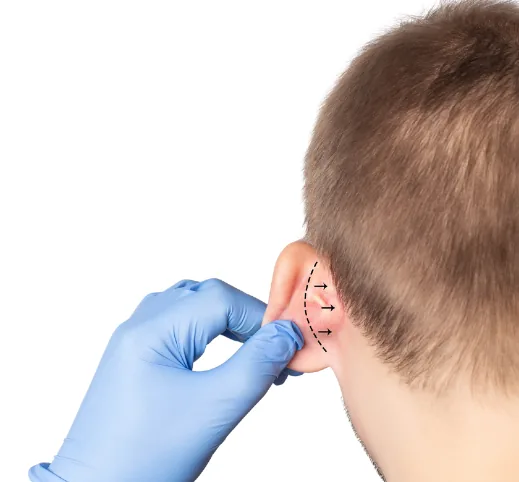
The Three Types of Otoplasty
Ear pinning sets prominent ears closer to the head. Ear reduction makes an ear that is larger than the patient would like smaller. Ear augmentation is used when part of the ear is underdeveloped or missing.
Some patients need one type, others a combination. The incisions are usually placed behind the ear, where the scar is well hidden in the fold between the ear and the head.
Otoplasty is about ears that look balanced with the face and with each other. Perfect symmetry is not realistic, because no two ears are identical even before surgery.
Correcting One Ear vs Both Ears
One Ear
Chosen when only one ear sticks out or is shaped differently, while the other already sits well.
The aim is to match the treated ear to the untreated one, so careful measurement of both ears matters most.
Both Ears
Chosen when both ears are prominent or both need reshaping, which is the more common situation.
Both ears are adjusted in the same operation, so they can be balanced against each other.
| Aspect | One ear | Both ears |
|---|---|---|
| Typical reason | Asymmetry: one ear differs | Both ears prominent or reshaped |
| Main planning challenge | Matching an untreated ear | Balancing two treated ears |
| Operating time | Usually shorter | Usually longer |
| Anaesthetic | Local or general, decided at consultation | Local or general, decided at consultation |
| Headband and dressing | Needed | Needed |
| Cost | Quoted after consultation | Quoted after consultation |
How Otoplasty Is Performed
The technique depends on the type of otoplasty, but the overall path is similar for most patients.
Assessment
Both ears are examined and measured, and the type of otoplasty is chosen. For children, timing and the child’s own wishes are discussed with the family.
Anaesthetic choice
Older children and adults may have local anaesthesia; others have a general anaesthetic. The choice depends on age, the procedure and comfort.
Reshaping the ear
Through an incision usually placed behind the ear, the cartilage is reshaped, repositioned or reduced and held with stitches.
Dressing
A dressing is placed over the ears to protect them and must be kept clean and dry.
Follow-up
The dressing is checked and removed at the practice, followed by a period of wearing a headband as advised.
Who Otoplasty Suits
Otoplasty is considered for people bothered by the appearance of their ears, provided they are in good health and the ears have reached close to adult size.
- Protruding ears – Ears that stand out from the side of the head
- Large ears – Ears that look out of proportion to the face
- Differently shaped ears – Ears with an unusual shape from birth
- Ears changed by injury – Shape altered after trauma
- Age about six or older – Ears are close to full size by then
For a child, surgery is planned when the child is old enough to cooperate with aftercare and, ideally, wants the change themselves.
Choosing the Right Time
Timing affects both comfort and how easily aftercare fits into daily life.
- Plan around school or work.Allow time off for the first days and a period of careful activity afterwards.
- Avoid contact sports.Sports that risk knocks to the ears wait until you are cleared.
- Allow for the headband.A headband is worn for a period after the dressing comes off, mainly at night.
- Think about hairstyles.Some patients plan a hairstyle that covers the ears while bruising settles.
Otoplasty Cost in South Africa
The practice publishes a range of R50,000 to R60,000 for otoplasty (see otoplasty prices in South Africa). The exact fee depends on the type of otoplasty, whether one or both ears are treated, the setting and the anaesthetic.
A written quote follows the consultation and lists what is included and what is billed separately.
Cosmetic ear surgery is generally self-funded. Reconstruction after injury may be considered differently by medical aids, which decide on a motivation.
What People Often Assume About Ear Surgery
Otoplasty is a common procedure, but a few assumptions are worth correcting.
Risks and Possible Complications
Recognised Risks of Cosmetic Ear Surgery
General: bleeding or a blood collection under the skin, infection, slow healing and anaesthetic reactions.
Shape and balance: the two ears may not match exactly, or part of the correction may relax over time.
Scarring: usually hidden behind the ear, but a scar can thicken or become noticeable.
Stitches: a buried stitch can occasionally work its way to the skin surface and need removal.
Sensation: numbness and tenderness are common at first and usually improve.
What Reduces Risk
- Keep the dressing dry – and in place until it is checked at the practice.
- Wear the headband – for the period advised to protect the new shape.
- Avoid knocks to the ears – including contact sport, until cleared.
- Report problems early – rather than waiting for the next appointment.
Contact the practice urgently if one ear becomes increasingly painful or swollen, the dressing becomes soaked, or there are signs of infection such as fever, discharge or spreading redness.
Medical disclaimer. This page is general information and does not replace a face-to-face consultation. Surgical decisions require an in-person assessment, a full consent discussion and the individual medical advice of your surgeon and anaesthetist.
Otoplasty South Africa: Frequently Asked Questions
Where is otoplasty performed?
At the practice of Dr Deon Weyers at Life Fourways Hospital, Johannesburg. Patients travel from across South Africa; there are no other branches.
Can otoplasty be done on one ear only?
Yes. When only one ear is prominent or shaped differently, it can be corrected to match the other ear.
What is the minimum age for ear surgery?
Ear surgery can be considered from about six years of age, when the ears are close to their adult size.
Is ear pinning the same as otoplasty?
Ear pinning is the most common type of otoplasty. Otoplasty also includes ear reduction and ear augmentation.
Will I be awake during the procedure?
Older children and adults may have local anaesthesia; in other cases a general anaesthetic is used. This is decided at consultation.
How much does otoplasty cost in South Africa?
The practice publishes a range of R50,000 to R60,000. A written quote is provided after your consultation.
How long is recovery?
Bruising usually fades in 7 to 10 days, and complete healing takes at least six weeks. Time off school or work is discussed when planning.
Do you see patients from Cape Town and Durban?
Yes. Patients from other cities travel to Fourways for consultation and surgery. See also otoplasty for Cape Town patients.
Speak to Dr Deon Weyers About Otoplasty
Dr Deon Weyers is a board-certified plastic and reconstructive surgeon, registered with the Health Professions Council of South Africa and a member of APRASSA. Every consultation, procedure and follow-up is with him personally. He sees patients from across South Africa at the practice in Fourways.
Call 011 875 1694
Office hours: Monday to Thursday 08:00 – 17:00, Friday 08:00 – 14:00 · send a message
Image credits: Hero, context and final panel image: about-the-practice-fourways-life-hospital-johannesburg.jpg, drdeon.co.za media library..